~80%
of primary PGE supply comes from Southern Africa and Russia *
4th
consecutive year of platinum market deficit forecast for 2026 †
US + EU
have both designated platinum a critical mineral ‡
<3 months
of above-ground platinum stock cover anticipated by end of 2026 †
Five forces, pulling in one direction
Concentrated supply, underestimated demand and an emerging policy response are converging on a single conclusion: the West needs new, secure sources of platinum group elements.
01 Concentrated, fragile supply
Roughly four out of every five ounces of newly mined PGE supply come from just two regions, Southern Africa and Russia. Both face structural headwinds: ageing mines, rising costs, power instability and, in Russia’s case, the added overlay of sanctions and geopolitical risk. No major new source has emerged to close the gap, and meaningful new supply takes years of exploration, permitting and construction to bring online. For a metal group this essential, that concentration is not a footnote. It is the central risk.
02 Demand the market underestimates
The demand story runs well beyond catalytic converters, and several of its largest drivers are still early in their growth.
MOBILITY
Hybrid Vehicles
Hybrids are the fastest-growing segment of the global car market and they carry increased PGE loadings rather than removing them. As hybrids take share from both conventional and battery-electric vehicles, they sustain catalytic (thus, PGE) demand for years. |
INVESTMENT
Chinese demand
Chinese appetite is broadening from jewelry into investment, with bars, coins and exchange products drawing new buyers while platinum trades at a persistent discount to gold. |
ENERGY
The hydrogen economy
Fuel cells and electrolyzers are a long-dated but scaling source of platinum demand, and a renewed focus on energy security is reinvigorating interest in hydrogen as a strategic technology. |
03 A deficit the market is only beginning to price
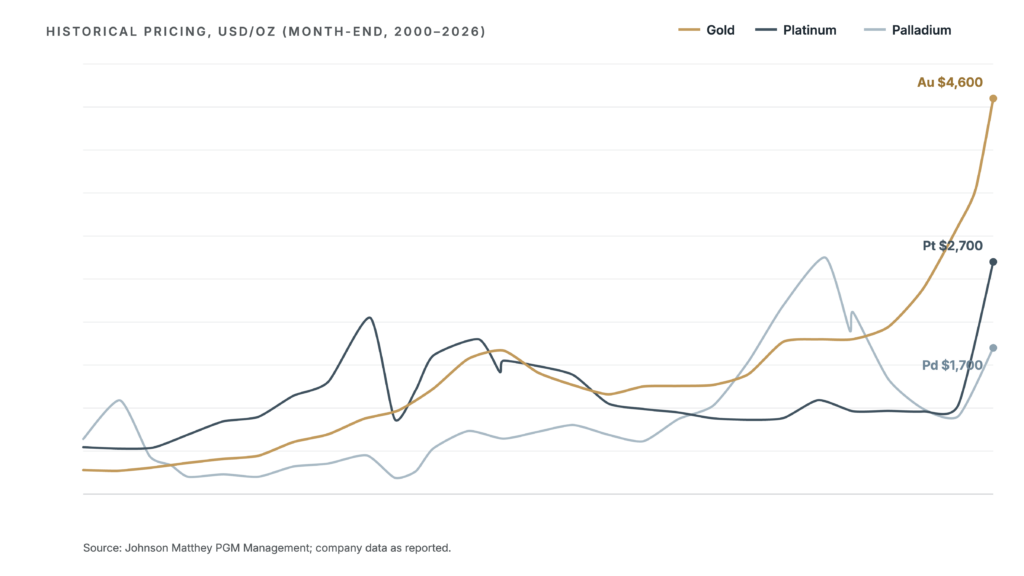
Platinum has been in structural deficit for several years, and 2026 is forecast to mark a fourth consecutive annual shortfall. Mine supply has stayed broadly flat even as prices have re-rated sharply, because higher prices cannot quickly conjure new mines. Above- ground stocks have absorbed the difference, and that cushion is thinning toward under three months of demand cover. The result is a market with little margin for further disruption, and a price signal that increasingly reflects scarcity rather than momentum.
04 From market risk to strategic priority
Supply concentration has moved from a market concern to a policy one. Platinum sits on the United States critical minerals list, and the European Union’s Critical Raw Materials Act has made securing platinum group metals a strategic priority. Industrial policy, security of supply and sovereign demand are now pulling in the same direction: diversifying PGE supply away from concentrated and contested jurisdictions. That is the layer that turns a well-located mining project into a strategic asset.
05 Where ValOre fits: A near-surface PGE district in a stable mining jurisdiction
Brazil is a stable, mining-friendly jurisdiction with established infrastructure and a clear permitting path. Pedra Branca is a district-scale, near-surface PGE system, and proprietary bioleaching research is targeting the processing economics that have historically held back weathered PGE ores elsewhere.
The macro case is strong enough to stand on its own. ValOre’s role is to be credibly and visibly positioned within it, with a defined path from resource toward a Preliminary Economic Assessment.
See how Pedra Branca is positioned within this market
See the Pedra Branca Project
Corporate Presentation