


TSX-V: VO Last: 0.07 Change: 0.00 | OTCQB: KVLQF Last: 0.05 Change: 0.00
TSX-V: VO     Last: 0.07     Change: 0.00
OTCQB: KVLQF     Last: 0.05     Change: 0.00

ValOre PGE Assays from Metallurgical Drilling at Pedra Branca Confirm Historical Drilling Averages in Curiu and Esbarro Zones
Drill Hole DD21ES15C significantly exceeds previous results: 77 m at 2.95 g/t 2PGE+Au from surface, incl. 6.4 m at 16.92 g/t 2PGE+Au and 0.52 g/t Rh from 29.7 m

Vancouver, B.C. ValOre Metals Corp. (“ValOre”; TSXV: VO; OTC: KVLQF; Frankfurt: KEQ0, “the Company”) today provided an update on metallurgy at ValOre’s 100%-owned Pedra Branca Platinum Group Elements (“PGE”, “2PGE+Au”) Project (“Pedra Branca”) in northeastern Brazil.

“We are very encouraged by confirmatory drill core assay results from the Esbarro and Curiu PGE deposits, which returned impressive, high-grade palladium-platinum through broad intercepts from surface,” stated ValOre’s VP of Exploration, Colin Smith. “In addition, we welcome metallurgist Chris Kaye to the ValOre team, whose extensive experience will help accelerate the advancement of the Pedra Branca Project.”

Key Updates on Metallurgical Drilling, Testwork and Personnel:

  • Ten HQ-size core drill holes totaling 591 metres (“m”) at the Curiu and Esbarro PGE deposit areas were completed, logged, sampled and assayed prior to planned metallurgical testwork;
  • All 10 drill holes confirmed the historically reported geology and returned high-grade, shallow PGE-mineralized intercepts including:
    • 77 m at 2.95 g/t 2PGE+Au from surface, incl. 45 m at 4.76 g/t 2PGE+Au, 0.1 g/t Rh from 16 m, and 6.4 m at 16.92 g/t 2PGE+Au and 0.52 g/t Rh from 30 m in drill hole DD21ES15C
    • 49 m at 2.03 g/t 2PGE+Au from 19 m, incl. 4.6 m at 11.94 g/t 2PGE+Au, 0.25 g/t Rh from 23.68 m in Drill hole DD21CU12A
    • 77 m at 1.01 g/t 2PGE+Au from surface in drill hole DD21PBE30A
    • 47 m at 1.51 g/t 2PGE+Au from surface in drill hole DD21CU12A;
  • Highly experienced metallurgist, Chris Kaye, has been engaged to oversee the current and future testwork campaigns;
  • Metallurgical testwork program at ALS Metallurgy Kamloops (“ALS”) expected to commence mid-October, with a primary focus on mineralogy and conventional processing circuits;
  • Composite samples have been selected and shipped.

*Reported core assay interval lengths are estimated to represent 95-100% true width

2021 Metallurgical Drill Program

Ten HQ-size core drill holes (totaling 591 m) were completed to provide PGE mineralized material for planned metallurgical testwork. Six holes (378 m) were drilled into the Esbarro deposit (394,000 ounces 2PGE+Au contained in an inferred resource of 9.9 million tonnes (“Mt”) grading 1.23 g/t 2PGE+Au), and four holes (213 m) were drilled into the Curiu deposit (1.6 Mt grading 1.93 g/t 2PGE+Au, containing 100,000 ounces).

All drill holes confirmed the historically reported mineralized ultramafic (“UM”) intrusion and returned broad, shallow, high-grade 2PGE+Au intercepts. See Table 1 below for a complete table of drill core assays and CLICK HERE for a map of the metallurgical drill hole locations at Esbarro and Curiu (Figure 1).

Table 1: Drill Core 2PGE+Au Assays from the 2021 Metallurgical Drill Program

Deposit Hole ID From
(m)
To
(m)
Length
(m)
Au
 (g/t)
Pd
(g/t)
Pt
(g/t)
2PGE+Au
(g/t)
Summary Interval
Esbarro DD21ES15C 0.00 77.00 77.00 0.04 2.06 0.85 2.95 77 m at 2.95 g/t 2PGE+Au from surface
incl. 45 m at 4.76 g/t 2PGE+Au, 0.1 g/t Rh from 16 m
and 6.4 m at 16.92 g/t 2PGE+Au 0.52 g/t Rh from 30 m
16.00 61.00 45.00 0.04 3.33 1.38 4.76
29.65 36.00 6.35 0.10 11.66 5.17 16.92
Esbarro DD21PBE30A 0.00 77.00 77.00 0.05 0.64 0.32 1.01 77 m at 1.01 g/t 2PGE+Au from surface
incl. 13 m at 2.71 g/t 2PGE+Au from 36 m
and 2.7 m at 7.82 g/t 2PGE+Au, 0.18 g/t Rh from 37 m
36.03 49.00 12.97 0.02 1.79 0.91 2.71
36.69 39.36 2.67 0.04 5.19 2.58 7.82
Esbarro DD21RW005A 0 56.12 56.12 0.01 0.73 0.39 1.13 56 m at 1.13 g/t 2PGE+Au from surface
incl. 17 m at 2.38 g/t 2PGE+Au from 17 m
and 1.3 m at 12.96 g/t 2PGE+Au from 17 m
16.77 33.64 16.87 0.02 1.61 0.75 2.38
16.77 18.08 1.31 0.03 9.41 3.52 12.96
Esbarro DD21PBE17A 0.00 31.34 31.34 0.01 1.48 0.45 1.95 31 m at 1.95 g/t 2PGE+Au from surface
incl. 18 m at 3.14 g/t 2PGE+Au from surface
0.00 17.81 17.81 0.01 2.45 0.68 3.14
Esbarro DD21ES13A 0.00 32.33 32.33 0.04 0.78 0.27 1.10 32 m at 1.10 g/t 2PGE+Au from surface
incl. 21 m at 1.47 g/t 2PGE+Au from surface
and 6.0 m at 2.80 g/t 2PGE+Au from surface
0.00 21.00 21.00 0.06 1.10 0.31 1.47
0.00 6.00 6.00 0.12 2.15 0.54 2.80
Esbarro DD21PBE35A 9.54 42.00 32.46 0.01 0.62 0.39 1.03 32 m at 1.03 g/t 2PGE+Au from 9.5 m
incl. 16 m at 1.67 g/t 2PGE+Au from 15 m
15.00 31.00 16.00 0.01 1.02 0.64 1.67
Curiu DD21CU12A 18.97 68.18 49.21 0.06 1.25 0.72 2.03 49 m at 2.03 g/t 2PGE+Au from 19 m
incl. 4.6 m at 11.94 g/t 2PGE+Au, 0.25 g/t Rh from 24 m
23.68 28.25 4.57 0.12 7.77 4.06 11.94
Curiu DD21CU26A 0.00 17.80 17.80 0.14 2.46 1.70 4.30 18 m at 4.30 g/t 2PGE+Au from surface
Curiu DD21CU22A 0.00 47.00 47.00 0.06 0.86 0.59 1.51 47 m at 1.51 g/t 2PGE+Au from surface
incl. 8.0 m at 4.47 g/t 2PGE+Au from surface
and 2.5 m at 3.89 g/t 2PGE+Au from 28 m
0.00 8.00 8.00 0.16 2.31 2.00 4.47
27.80 30.30 2.50 0.10 2.73 1.06 3.89
Curiu DD21CU15A 0.00 37.00 37.00 0.05 1.00 0.65 1.70 37 m at 1.70 g/t 2PGE+Au from surface
incl. 5.9 m at 5.30 g/t 2PGE+Au from 1.0 m
1.00 6.85 5.85 0.12 2.79 2.40 5.30

*Reported core assay interval lengths are estimated to represent 95-100% true width

ALS Metallurgy Testwork Program

The ALS testwork program will comprise a detailed mineralogical assessment and conventional flotation tests on a composite sample of ¼ HQ drill core from the Curiu deposit. A Particle Size Analysis (“PSA”) study will be performed prior to the mineralogical assessment, and subsequent rougher floatation, Davis Tube and magnetic separation rougher tests will be completed. Assays will be taken on the heads, fractions, and final test products to assess metallurgical recoveries.

Historical metallurgical testing of material from the Pedra Branca project has involved assessing a range of different processing alternatives, including conventional treatment such as grinding, and flotation as it relates to alterations and material types. This testwork has produced a valuable insight into the metallurgical response of the different material types associated with the project; particularly with respect to the Curiu material. The ALS metallurgical testwork program is designed to leverage from this historical testing and incorporate mineralogical assessment of rock types while evaluating modifications to the processing route and optimizing the treatment criterion developed to date.

About ALS Metallurgy Kamloops

ALS has established a reputation as a leader in process development, circuit optimization and mineralogical analysis. As the global leader in metallurgical testing and consulting services for mineral process flowsheet development and optimization, ALS offers mineral processing testing by both bench scale and pilot scale facilities, hydrometallurgical and mineralogical test services, and project management by expert metallurgists.

CLICK HERE for more information regarding ALS Metallurgy Kamloops.

Chris Kaye, Metallurgist

ValOre will draw on the experience of metallurgist, Chris Kaye (President & Principal Process Engineer of Mine and Quarry Engineering Services Inc., “MQes”), to oversee current and future metallurgical testwork programs for Pedra Branca. Chris has over 35 years’ experience in mining and mineral processing, working with operating mines, engineering companies and consulting companies. He has expertise in PGEs, Gold, Silver, Copper, Nickel, Lead, Zinc and Aluminum projects in Australia, Finland, Canada, Zambia, Argentina, Chile, Mexico and the USA, with extensive experience in project development, managing plants, and developing “green-field” projects.

CLICK HERE for more information regarding MQes.

Quality Control/Quality Assurance (“QA/QC”) and Grade Interval Reporting

CLICK HERE for a summary of ValOre’s policies and procedures related to QA/QC and grade interval reporting.

Qualified Person (QP)

The technical information in this news release has been prepared in accordance with Canadian regulatory requirements set out in NI 43-101 and reviewed and approved by Colin Smith, P.Geo., ValOre’s QP and Vice President of Exploration.

About ValOre Metals Corp.

ValOre Metals Corp. (TSXV: VO) is a Canadian company with a portfolio of high‐quality exploration projects. ValOre’s team aims to deploy capital and knowledge on projects which benefit from substantial prior investment by previous owners, existence of high-value mineralization on a large scale, and the possibility of adding tangible value through exploration, process improvement, and innovation.

In May 2019, ValOre announced the acquisition of the Pedra Branca Platinum Group Elements (PGE) property, in Brazil, to bolster its existing Angilak uranium, Genesis/Hatchet uranium and Baffin gold projects in Canada.

The Pedra Branca PGE Project comprises 51 exploration licenses covering a total area of 55,984 hectares (138,339 acres) in northeastern Brazil. At Pedra Branca, 5 distinct PGE+Au deposit areas host, in aggregate, a current Inferred Resource of 1,067,000 ounces 2PGE+Au contained in 27.2 million tonnes grading 1.22 g/t 2PGE+Au (CLICK HERE for ValOre’s July 23, 2019 news release). All the currently known Pedra Branca inferred PGE resources are potentially open pittable.

Comprehensive exploration programs have demonstrated the "District Scale" potential of ValOre’s Angilak Property in Nunavut Territory, Canada that hosts the Lac 50 Trend having a current Inferred Resource of 2,831,000 tonnes grading 0.69% U3O8, totaling 43.3 million pounds U3O8. For disclosure related to the inferred resource for the Lac 50 Trend uranium deposits, please CLICK HERE for ValOre's news release dated March 1, 2013.

ValOre’s team has forged strong relationships with sophisticated resource sector investors and partner Nunavut Tunngavik Inc. (NTI) on both the Angilak and Baffin Gold Properties. ValOre was the first company to sign a comprehensive agreement to explore for uranium on Inuit Owned Lands in Nunavut Territory and is committed to building shareholder value while adhering to high levels of environmental and safety standards and proactive local community engagement.

On behalf of the Board of Directors,

“Jim Paterson”

James R. Paterson, Chairman and CEO

ValOre Metals Corp.

For further information about ValOre Metals Corp., or this news release, please visit our website at www.valoremetals.com or contact Investor Relations at 604.653.9464, or by email at [email protected].

ValOre Metals Corp. is a proud member of Discovery Group. For more information please visit: http://www.discoverygroup.ca/

Neither the TSX Venture Exchange nor its Regulation Services Provider (as that term is defined in the policies of the TSX Venture Exchange) accepts responsibility for the adequacy or accuracy of this release.

This news release contains “forward-looking statements” within the meaning of applicable securities laws. Although ValOre believes that the expectations reflected in its forward-looking statements are reasonable, such statements have been based on factors and assumptions concerning future events that may prove to be inaccurate. These factors and assumptions are based upon currently available information to ValOre. Such statements are subject to known and unknown risks, uncertainties and other factors that could influence actual results or events and cause actual results or events to differ materially from those stated, anticipated or implied in the forward-looking statements. A number of important factors including those set forth in other public filings could cause actual outcomes and results to differ materially from those expressed in these forward-looking statements. Factors that could cause the actual results to differ materially from those in forward-looking statements include the future operations of ValOre and economic factors. Readers are cautioned to not place undue reliance on forward-looking statements. The statements in this press release are made as of the date of this release and, except as required by applicable law, ValOre does not undertake any obligation to publicly update or to revise any of the included forward-looking statements, whether as a result of new information, future events or otherwise. ValOre undertakes no obligation to comment on analyses, expectations or statements made by third parties in respect of ValOre, or its financial or operating results or (as applicable), their securities.
Vancouver, B.C. ValOre Metals Corp. (“ValOre”; TSXV: VO; OTC: KVLQF; Frankfurt: KEQ0, “the Company”) today announced encouraging STEINERT ore sorting testwork results for ValOre’s 100%-owned Pedra Branca Platinum Group Element (“PGE”) Project in northeastern Brazil. Results from the ore sorting program, which used a set of 100 re-assayed and catalogued 5-cm samples of historical NQ drill core from the Esbarro PGE deposit, demonstrated distinct density responses for mineralized rock types, as well as barren granites and gneisses.

Sensory-based rock sorting technologies such as STEINERT can concentrate ores, remove waste rock and cut process costs to generate significant positive economic implications for both metallurgy and OPEX.

“STEINERT ore sorting testwork was initiated to assess the sortability of mineralized and non-mineralized rock types at Pedra Branca, with the ultimate goal of improving metallurgical performance and processing economics. As part of this test work, the sample set taken from historic NQ drill core was re-assayed and returned the highest-grade value from a drill core sample in the history of the project, clearly demonstrating the presence of high-grade, near-surface PGEs at Pedra Branca,” stated ValOre’s Chairman and CEO, Jim Paterson. “These results are very encouraging and warrant immediate expansion of this testwork. ValOre geologists are preparing a bulk sample to support a comprehensive, quantitative follow-up sorting test program.”

Highlights from Ore Sorting Testwork at Esbarro Deposit:

  • Sensor-based ore sorting testwork by STEINERT GmbH demonstrated excellent rock density sortability, evidenced by distinct X-Ray Transmission (“XRT”) responses for both PGE mineralized and barren Pedra Branca rock types;
  • Chromitite samples returned the most distinct XRT response, demonstrating the greatest potential for ore sorting technology to facilitate a high-grade fraction;
  • Barren granite and gneiss samples exhibited a unique XRT response, indicating the potential to separate waste rock from PGE-mineralized rock allowing for less process dilution;
  • PGE-mineralized dunite, peridotite and serpentinite samples displayed strong XRT response groupings, revealing further potential for sensor-based ore sorting;
  • Re-assaying of historical drill core for STEINERT from the Esbarro PGE deposit returned the highest-grade drill core sample in the history of the project from a 5-centimetre (“cm”) sample of NQ drill core at 30.35 metres (“m”) depth in drill hole DD18ES15A:
    • 176.52 grams per tonne (“g/t”) palladium + platinum + gold (“2PGE+Au”)
    • Comprising 133.35 g/t Pd, 42.24 g/t Pt, and 0.93 g/t Au
    • Also returned 3.30 g/t rhodium (“Rh”), or 179.82 g/t 3PGE+Au;
  • PGE grades for the major lithologies selected for ore sorting testwork include:
    • Chromitites (“Cr”, “Cr-reef”): 0.17-30.44 g/t 2PGE+Au (average 10.33 g/t, excluding sample from DD18ES15A grading 176.52 g/t 2PGE+Au)
    • Dunites/peridotites/serpentinites/pyroxenites: 0.07-10.15 g/t 2PGE+Au (average 1.86 g/t)
    • Granites/gneisses/amphibolites: barren;
  • Based on the encouraging initial sortability test results, ValOre will broaden the scope for more thorough quantitative assessment with a 300 kilogram (“kg”) bulk sample to support additional testwork at STEINERT.

Esbarro PGE Deposit Ore Sorting Testwork

The Esbarro PGE deposit hosts an at-surface resource estimate of 9.9 million tonnes (“Mt”) grading 1.23 g/t 2PGE+Au totaling 394,000 ounces (“oz”). CLICK HERE for the Pedra Branca NI 43-101 Technical Report. The resource estimate is supported by 91 drill holes, with an average hole spacing of 45 m and is situated within a 3-kilometre (“km”) radius of additional at-surface PGE resource areas, Cedro (4.2 Mt grading 1.10 g/t 2PGE+Au totaling 151,000 oz) and Curiu (1.6 Mt grading 1.93 g/t 2PGE+Au totaling 100,000 oz). CLICK HERE for Figure 1A and 1B, showing the location of the five Pedra Branca PGE resource areas and a detailed view of Esbarro, respectively.

STEINERT ore sorting testwork was initiated to assess the sortability of PGE mineralized rocks from barren rocks at Pedra Branca, with the ultimate goal of improving metallurgical performance and processing economics. One hundred historical drill core samples from six representative rock types were submitted from the Esbarro deposit, and sensory-based results were compared with assay data from SGS, Vespasiano, Minas Gerais to assess both rock type- and grade-dependent sortability. CLICK HERE for Table 1, showing the full list of samples, assay results, and sensor results.

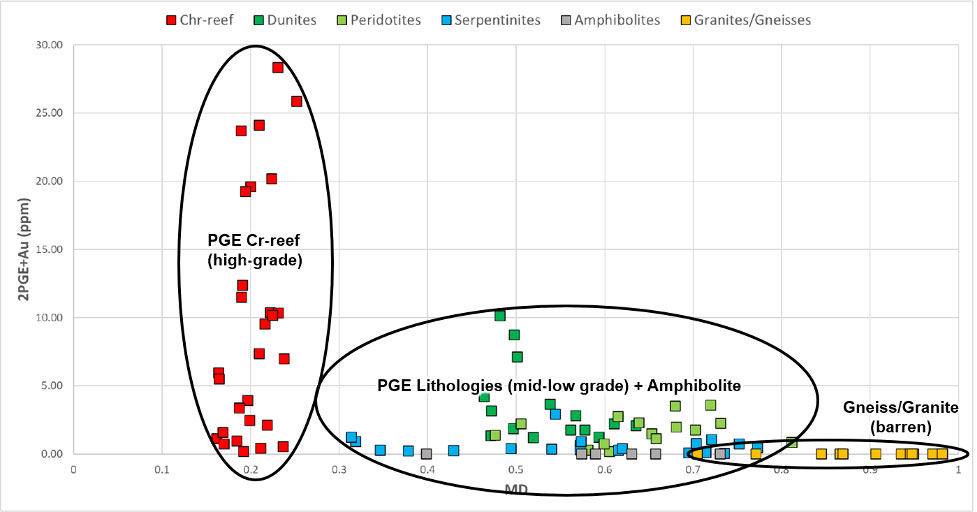
Density data from STEINERT XRT analyses demonstrated distinct sensory responses for mineralized rock types (chromitites, dunites, peridotites) and barren lithologies (granites and gneisses). The distinct XRT-assessed densities reported herein demonstrate excellent potential sortability of:

  • high-grade PGE rocks types (chromitite);
  • low- to medium-grade PGE rock types (dunites, peridotites, serpentinites, pyroxenites); and
  • barren waste rock types (granites and gneisses).

XRT density data is recorded as Minimum Density (“MD”), which reports the proportion of XRT-defined pixels inside the low-density curve, with lower MD values representing higher rock density. See Figure 2 Table 2 below for a graph of 2PGE+Au (g/t) versus MD, and a summary table of average MD values for each rock type, respectively.

Figure 2: Graph of 2PGE+Au (g/t) versus MD, Demonstrating Excellent Sortability

Figure 2

Table 2: Summary of MD Values, Demonstrating Excellent Sortability

Rock Type # Samples Relative Grade Average MD
Chromitite 30 High (avg. 10 g/t) 0.20
Dunite 15 Medium (avg. 3.5 g/t) 0.53
Peridotite 15 Medium (avg. 1.8 g/t) 0.64
Serpentinite/Pyroxenite 9 Low (avg. 0.4 g/t) 0.60
Serpentinite/Dunite 11 Low (avg. 0.8 g/t) 0.55
Gneiss/Granite/Amphibolite 20 Barren 0.78
Note: MD (Minimum Density) represents XRT proportion of pixels inside the low-density curve, per particle. Lower MD = higher density.

Assaying of the 100 core samples used for STEINERT testwork returned the highest-grade drill core sample in the history of the Pedra Branca project: 176.52 g/t 2PGE+Au (133.35 g/t Pd, 42.24 g/t Pt and 0.93 g/t Au), in addition to 3.30 g/t Rh (179.82 g/t 3PGE+Au). This sample was collected from a 5-cm sample of NQ drill core at 30.35 m depth in drill hole DD18ES15A. This clearly demonstrates the presence of high-grade, near-surface PGEs at Pedra Branca. See Table 3 below for the 3PGE+Au assay results.

Table 3: Assay Results for Core Sample 99035

Drill Hole Sample Depth
(m)
Au
(g/t)
Pd
(g/t)
Pt
(g/t)
2PGE+Au
(g/t)
Rh
(g/t)
3PGE+Au
(g/t)
DD18ES15A 99035 30.4 0.93 133.35 42.24 176.52 3.30 179.82

About STEINERT Ore Sorting

STEINERT GmbH supplies sensory-based rock sorting technologies to operating mining projects around the world. Sorting waste rock from ore at an early processing stage has significant positive economic implications for reducing both metallurgy and operating costs.

XRT is ideally suited for ore sorting because the x-ray radiation can penetrate stones with particle sizes up to 100 mm. In addition to XRT, STERINERT offers further sensors that can be combined with one another in a multi-faceted sensory approach. X-Ray Fluorescence (“XRF”) can be used to determine and sort individual chemical elements very precisely. Further, optical sorting and lasers are very well suited to the detection of ores with different colours, such as copper oxide, or crystalline structures in quartz.

Further information about STEINERT ore sorting can be found in the link below:
https://steinertglobal.com/

Qualified Person (QP)

The technical information in this news release has been prepared in accordance with Canadian regulatory requirements set out in NI 43-101 and reviewed and approved by Colin Smith, P.Geo., ValOre’s QP, who oversees New Project Review for ValOre.

About ValOre Metals Corp.

ValOre Metals Corp. (TSXV: VO) is a Canadian company with a portfolio of high‐quality exploration projects. ValOre’s team aims to deploy capital and knowledge on projects which benefit from substantial prior investment by previous owners, existence of high-value mineralization on a large scale, and the possibility of adding tangible value through exploration, process improvement, and innovation.

In May 2019, ValOre announced the acquisition of the Pedra Branca Platinum Group Elements (PGE) property, in Brazil, to bolster its existing Angilak uranium, Genesis/Hatchet uranium and Baffin gold projects in Canada.

The Pedra Branca PGE Project comprises 38 exploration licenses covering a total area of 38,940 hectares (96,223 acres) in northeastern Brazil. At Pedra Branca, 5 distinct PGE+Au deposit areas host, in aggregate, a current Inferred Resource of 1,067,000 ounces 2PGE+Au contained in 27.2 million tonnes grading 1.22 g/t 2PGE+Au (see ValOre’s July 23, 2019 news release). All the currently known Pedra Branca inferred PGE resources are potentially open pittable.

Comprehensive exploration programs have demonstrated the "District Scale" potential of ValOre’s Angilak Property in Nunavut Territory, Canada that hosts the Lac 50 Trend having a current Inferred Resource of 2,831,000 tonnes grading 0.69% U3O8, totaling 43.3 million pounds U3O8. For disclosure related to the inferred resource for the Lac 50 Trend uranium deposits, please refer to ValOre's news release of March 1, 2013.

ValOre’s team has forged strong relationships with sophisticated resource sector investors and partner Nunavut Tunngavik Inc. (NTI) on both the Angilak and Baffin Gold Properties. ValOre was the first company to sign a comprehensive agreement to explore for uranium on Inuit Owned Lands in Nunavut Territory and is committed to building shareholder value while adhering to high levels of environmental and safety standards and proactive local community engagement.

On behalf of the Board of Directors,

“Jim Paterson”

James R. Paterson, Chairman and CEO

ValOre Metals Corp.

For further information about, ValOre Metals Corp. or this news release, please visit our website at www.valoremetals.com or contact Investor Relations toll free at 1.888.331.2269, at 604.653.9464, or by email at [email protected].

ValOre Metals Corp. is a proud member of Discovery Group. For more information please visit: discoverygroup.ca  

Neither the TSX Venture Exchange nor its Regulation Services Provider (as that term is defined in the policies of the TSX Venture Exchange) accepts responsibility for the adequacy or accuracy of this release.

This news release contains “forward-looking statements” within the meaning of applicable securities laws. Although ValOre believes that the expectations reflected in its forward-looking statements are reasonable, such statements have been based on factors and assumptions concerning future events that may prove to be inaccurate. These factors and assumptions are based upon currently available information to ValOre. Such statements are subject to known and unknown risks, uncertainties and other factors that could influence actual results or events and cause actual results or events to differ materially from those stated, anticipated or implied in the forward-looking statements. A number of important factors including those set forth in other public filings could cause actual outcomes and results to differ materially from those expressed in these forward-looking statements. Factors that could cause the actual results to differ materially from those in forward-looking statements include the future operations of ValOre and economic factors. Readers are cautioned to not place undue reliance on forward-looking statements. The statements in this press release are made as of the date of this release and, except as required by applicable law, ValOre does not undertake any obligation to publicly update or to revise any of the included forward-looking statements, whether as a result of new information, future events or otherwise. ValOre undertakes no obligation to comment on analyses, expectations or statements made by third parties in respect of ValOre, or its financial or operating results or (as applicable), their securities.

CEO Update: 2021 Focus Building on 2020 Success – Jan 6, 2021

Vancouver, B.C. ValOre Metals Corp. (“ValOre”; the “Company”; TSXV: VO; OTC: KVLQF; Frankfurt: KEQ0) today announced preliminary metallurgical results for cyanide leach and Falcon Ultra-Fine (“UF”) testwork for ValOre’s 100%-owned Pedra Branca Platinum Group Element (“PGE”) Project in northeastern Brazil.

“We are extremely pleased with both the high palladium recoveries achieved with cyanidation tests and the gravity concentration tests which showed more than 80% of the platinum recovered in 32% of the mass,” stated ValOre’s Chairman and CEO, Jim Paterson. These favorable and complimentary results significantly increase the optionality related to future development of the Pedra Branca project and they provide real impetus for ValOre to continue to perform tests to optimize conditions and improve metallurgical recoveries.”

Highlights from Cyanide Leach and Falcon UF Gravity Tests at Pedra Branca

  • Hot cyanide metallurgical test recoveries of 84.4%, 88.5% and 91.7% palladium (“Pd”) were achieved;
  • Falcon UF gravity test work was very effective at concentrating platinum (“Pt”) with 73.3% Pt recovered in only 9.6% of the mass and 82.6% Pt recovered in 32.1% of the mass;
  • Falcon UF gravity concentration may serve to optimize conditions required for the Platsol™ process (see news release date November 2, 2020) by favorably rejecting acid-consuming minerals, and consequently, three subsequent Platsol™ optimization tests have been initiated.

PGE Cyanidation Testwork

Palladium and platinum are readily soluble in a cyanide leach solution under certain chemical conditions. To assess the potential of cyanide leaching as a means to recover PGEs at Pedra Branca, three initial 48-hour hot cyanide leach tests were conducted at SGS Lakefield, Ontario (“SGS”). These tests were conducted on: 1) composite drill core sample from the Curiu 2PGE+Au deposit (100,000oz at 1.93 g 2PGE+Au/t); 2) an outcrop sample from the Trapia 2PGE+Au deposit (219,000oz at 1.19 g 2PGE+Au/t); and 3) tailings material collected from the first Falcon UF Gravity Concentrator test (see “Falcon UF Gravity Separation” below). Recoveries of 84.4%, 88.5% and 91.7% Pd were achieved in 48-hour leach experiments. See Table 1 below for a summary of cyanidation results, and Table 2 below for a description of sample details.

The hot cyanide leach tests were performed with the following conditions:

  • Grind size = 20-30 μm (P80)
  • Pulp density = 33% solids (w/w)
  • Pulp temperature = 50°C
  • Cyanide concentration = 20 g/L NaCN (maintained)
  • Dissolved Oxygen = 20 mg/L (maintained)
  • Retention time = 48 hours
  • Kinetic solution subsamples assayed for Pt and Pd after ~6, 24 and 48 hours

Table 1: Summary of Hot Cyanide Leach Results

Sample Tailing from Test % Extraction
Platinum Palladium
6 h 24 h 48 h 6 h 24 h 48 h
Curiu Core 1 2 2.6 81 88 91.7
Trapia West Outcrop 2 3 4.2 47 74 84.4
Curiu Core G1 5 5 7.2 83 90 88.5

Table 2: Description of Sample Details

Sample Type Source Weight
Received
Pd
(g/t)
Pt
(g/t)
Rh
(g/t)
Au
(g/t)
3PGE+Au
(g/t)
Historical Drill Core Curiu Deposit 20-25 kg 3.83 6.86 0.25 0.24 11.2
Outcrop Curiu Deposit 20-25 kg 7.86 3.95 0.45 0.30 12.6
Outcrop Trapia West Deposit 20-25 kg 21.6 17.0 0.25 0.83 39.6

The strong leachability of Pd in all three tests warrants subsequent cyanidation tests aimed at improving the performance of Pt recoveries. The addition of chloride and/or iodine as an additive in future testing may promote reaction activity and this could positively impact the recoveries of both Pt and Pd.

About Cyanidation of PGEs

Further information about cyanide leaching can be found in the link below:

https://www.sgs.ca/en/mining/metallurgy-and-process-design/cyanidation-technologies/cyanide-leaching

Falcon UF Gravity Separation

Previous mineralogical studies of Pedra Branca mineralized ultramafic rocks suggest a very fine nature to the PGE minerals (<9 micrometer (“μm”)) and thus multiple rounds of testwork have been initiated to assess the potential to upgrade feed material by means of a fine grind (-20 to -38 μm) followed by gravity separation using the Falcon UF Gravity Concentrator. The primary objective is to scavenge ultra-fine mineral particles that are typically rejected from conventional gravity processing circuits as slimes.

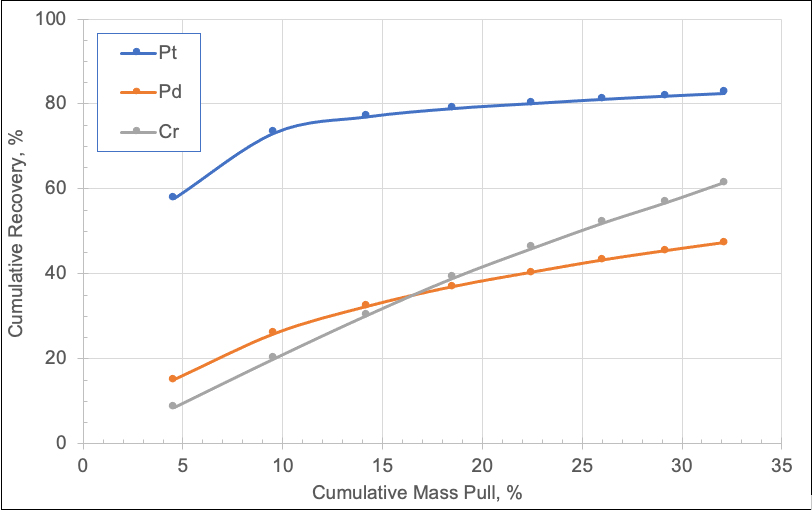
The first round of Falcon UF testwork (“G1”) was completed on a sample of historical drill core from the Curiu 2PGE+Au deposit (NI 43-101 resource of 100,000oz 2PGE+Au at 1.93 g/t). A summary of the samples tested is included in Table 2 above. Platinum responded very favorably to Falcon UF Gravity concentration, with 73.3% Pt separated into only 9.6% of the mass, 82.6% Pt separated into 32.1% of the mass, and 57.8% Pt on the first mass pull (4.6% of the mass). Palladium responded less favorably to Falcon UF concentration, with 47.7% Pd recovered in 32.1% of the mass. See Figure 1 and Table 3 below for a summary of G1 test results, which were run under the following test protocols: 5 kg feed at -38 μm, 10-15% solids with ~ 3 litres/minute pulp feed rate.

  • 300 G-Force centrifugal pressure
  • Recover Pass 1 Concentrate and retain
  • Repass Pass 1 Tailing
  • Repeat for a total of 8 passes – expected mass recovery of 20-25% in total
  • Filter, dry and weigh all products and submit for assay (8 concentrates, 1 tailing), including Cr, Pt and Pd
  • Metallurgical balance relating mass recovery to PGE recovery

Figure 1: Summary Graph of G1 Falcon UF Gravity Test Results

Figure 1

Table 3: Summary Table of G1 Falcon UF Gravity Test Results

Product Mass Assays, g/t Distribution %
g % Pt, g/t Pd, g/t Cr, % Pt Pd Cr
Pass 1 Concentrate 226.7 4.6 44.5 21.9 15.1 57.8 15.0 8.6
Pass 1+2 Concentrate 477.3 9.6 26.8 17.9 16.8 73.3 25.9 20.1
Pass 1-3 Concentrate 707.1 14.2 19.0 15.1 17.1 77.0 32.3 30.2
Pass 1-4 Concentrate 921.6 18.5 15.0 13.2 16.9 79.0 37.0 39.0
Pass 1-5 Concentrate 1121.0 22.5 12.5 11.9 16.4 80.2 40.4 46.1
Pass 1-6 Concentrate 1297.9 26.1 10.9 11.0 16.0 81.2 43.3 52.0
Pass 1-7 Concentrate 1455.6 29.2 9.8 10.3 15.6 82.0 45.5 56.9
Pass 1-8 Concentrate 1600.1 32.1 9.0 9.8 15.4 82.6 47.4 61.6

Given the strong performance of Pt concentration in the G1 test, a subsequent round of Falcon UF concentration testwork (“G2”) was performed, aimed at further improving recoveries by a sequential coarse-to-fine grind. G2 was designed to examine the response of coarsely ground (~100 µm P80) material to standard gravity recovery techniques (Wilfley table), followed by fine grinding of the tailing (P80 = ~20 µm) and processing at high G-Force with the Falcon UF test procedure. This assumes that the PGEs were predominantly associated with chromite and that coarse chromite may concentrate somewhat efficiently relative to the lighter matrix minerals.

Platinum once again responded well to the combined Wilfley + Falcon UF process, with 76.4% recovered in 30.6% of the mass (Wilfley concentrate + Falcon pass 1 concentrate), and 86.9% recovered in 56.1% of the mass in the combined Wilfley + 4 pass Falcon concentrate. Palladium showed a slight improvement to G1 results, but required a higher mass pull, with recovery curves flattening at ~30% mass pull. The Wilfley stage did not show a marked improvement on G1 results. CLICK HERE for Figure 2 and Table 4 for summaries of the G2 test results.

The strong performance of Pt in both the G1 and G2 Falcon UF gravity tests, combined with strong leachability of Pd seen in the three cyanidation tests presents two highly complementary processes to concentrate and recover Pd and Pt at Pedra Branca. High-priority follow-up testwork is planned to further optimize conditions and improve metallurgical recoveries.

About Falcon UF Gravity Separation

Further information about Falcon UF gravity separation can be found in the link below:

https://minerals.seprosystems.com/equipment/falcon-uf-gravity-concentrators/

ABOUT SGS

SGS is the world’s leading inspection, verification, testing and certification company. SGS is recognized as the global benchmark for quality and integrity. With more than 89,000 employees, SGS operates a network of more than 2,600 offices and laboratories around the world.

SGS fit-for-purpose solutions encompass the skills of qualified geologists, geostatistician, analytical chemists, mineralogists, metallurgists, process engineers and mining engineers brought together to provide accurate and timely mineral and process evaluation services across the entire mining life cycle.

Qualified Person (QP)

The technical information in this news release has been prepared in accordance with Canadian regulatory requirements set out in NI 43-101 and reviewed and approved by Colin Smith, P.Geo., ValOre’s QP, who oversees New Project Review for ValOre.

About ValOre Metals Corp.

ValOre Metals Corp. (TSXV: VO) is a Canadian company with a portfolio of high‐quality exploration projects. ValOre’s team aims to deploy capital and knowledge on projects which benefit from substantial prior investment by previous owners, existence of high-value mineralization on a large scale, and the possibility of adding tangible value through exploration, process improvement, and innovation.

In May 2019, ValOre announced the acquisition of the Pedra Branca Platinum Group Elements (PGE) property, in Brazil, to bolster its existing Angilak uranium, Genesis/Hatchet uranium and Baffin gold projects in Canada.

The Pedra Branca PGE Project comprises 38 exploration licenses covering a total area of 38,940 hectares (96,223 acres) in northeastern Brazil. At Pedra Branca, 5 distinct PGE+Au deposit areas host, in aggregate, a NI 43-101 Inferred Resource of 1,067,000 ounces 2PGE+ Au contained in 27.2 million tonnes grading 1.22 g/t 2PGE+Au (see ValOre’s July 23, 2019 news release). PGE mineralization outcrops at surface and all of the currently known inferred resources are potentially open pittable.

Comprehensive exploration programs have demonstrated the "District Scale" potential of ValOre’s Angilak Property in Nunavut Territory, Canada that hosts the Lac 50 Trend having a NI 43‐101 Inferred Resource of 2,831,000 tonnes grading 0.69% U3O8, totaling 43.3 million pounds U3O8. For disclosure related to the inferred resource for the Lac 50 Trend uranium deposits, please refer to ValOre's news release of March 1, 2013.

ValOre’s team has forged strong relationships with sophisticated resource sector investors and partner Nunavut Tunngavik Inc. (NTI) on both the Angilak and Baffin Gold Properties. ValOre was the first company to sign a comprehensive agreement to explore for uranium on Inuit Owned Lands in Nunavut Territory and is committed to building shareholder value while adhering to high levels of environmental and safety standards and proactive local community engagement.

On behalf of the Board of Directors,

"Jim Paterson"James R. Paterson, Chairman and CEO

ValOre Metals Corp.

For further information about, ValOre Metals Corp. or this news release, please visit our website at valoremetals.com or contact Investor Relations toll free at 1.888.331.2269, at 604.646.4527, or by email at [email protected].

ValOre Metals Corp. is a proud member of Discovery Group. For more information please visit: discoverygroup.ca  

Neither the TSX Venture Exchange nor its Regulation Services Provider (as that term is defined in the policies of the TSX Venture Exchange) accepts responsibility for the adequacy or accuracy of this release.

This news release contains “forward-looking statements” within the meaning of applicable securities laws. Although ValOre believes that the expectations reflected in its forward-looking statements are reasonable, such statements have been based on factors and assumptions concerning future events that may prove to be inaccurate. These factors and assumptions are based upon currently available information to ValOre. Such statements are subject to known and unknown risks, uncertainties and other factors that could influence actual results or events and cause actual results or events to differ materially from those stated, anticipated or implied in the forward-looking statements. A number of important factors including those set forth in other public filings could cause actual outcomes and results to differ materially from those expressed in these forward-looking statements. Factors that could cause the actual results to differ materially from those in forward-looking statements include the future operations of ValOre and economic factors. Readers are cautioned to not place undue reliance on forward-looking statements. The statements in this press release are made as of the date of this release and, except as required by applicable law, ValOre does not undertake any obligation to publicly update or to revise any of the included forward-looking statements, whether as a result of new information, future events or otherwise. ValOre undertakes no obligation to comment on analyses, expectations or statements made by third parties in respect of ValOre, or its financial or operating results or (as applicable), their securities.

Vancouver, B.C. ValOre Metals Corp. (“ValOre”; the “Company”; TSXV: VO; OTC: KVLQF; Frankfurt: KEQ0) today announced metallurgical results for two preliminary Platsol™ tests, and the initiation of multiple optimization studies for ValOre’s 100%-owned Pedra Branca Platinum Group Element (“PGE”) Project in northeastern Brazil.

“The pace of success at Pedra Branca has increased dramatically in the last three months, including today’s release of PGE metallurgical recovery rates of in excess of 93% for palladium and 95% for platinum using the Platsol™ process,” stated ValOre’s Chairman and CEO, Jim Paterson. “Together with an aggressive property-wide exploration program, we are now focused on rapidly optimizing the conditions, procedures and processes to further maximize the upside potential of the Pedra Branca project.”

Highlights from Platsol™ Tests and Optimization Studies at Pedra Branca

  • Sample material for the Platsol™ tests was collected from outcrops at the Trapia and Curiu deposits areas at Pedra Branca;
  • Platsol™ metallurgical test recoveries of 93.4 to 93.6% for palladium (“Pd”) and 95.3 to 95.7% for platinum (“Pt”) were achieved in two tests conducted at SGS Lakefield, Ontario (“SGS”);
  • Two additional Platsol™ tests will now be performed by SGS to determine the effects of adding elemental sulphur to the autoclave to optimize conditions required for PGE and gold (Au) recoveries;
  • A comprehensive mineralogical evaluation is on-going at SGS to characterize the speciation of palladium and platinum in Pedra Branca mineralization to guide future process optimization initiatives;
  • Falcon Ultra-Fine (“UF”) gravity separation testwork continues as a potential preconcentration circuit to upgrade feed material and improve mass pull;
  • Hot cyanide leach testwork has been initiated to assess the recovery rates of palladium, platinum and gold in a cyanide leaching process;
  • STEINERT sensor-based ore sorting testwork will commence shortly with the shipment of 100 representative chip samples from historic drilling at the Esbarro deposit.

Platsol™ Metallurgical Testwork

Metallurgical recovery results from two Platsol™ leach tests show recovery rates of 93.4 to 93.6% for Pd and 95.3 to 95.7% for Pt. Samples tested were collected from outcrops at two of the five NI 43-101 defined 2PGE+Au deposits areas, namely Trapia (219,000oz at 1.19 g 2PGE+Au/t) and Curiu (100,000oz at 1.93 g 2PGE+Au/t). See Table 1 below for a summary of results and Table 2 below for sample descriptions.

Table 1: Summary of Preliminary Results of Platsol Testwork

Test Final PLS, mg/L Final Residue, g/t % Recovered Head Grades, g/t
Pt Pd Pt Pd Rh Au Pt Pd * Rh * Au Pt Pd Rh Au
Trapia Outcrop 3.25 4.29 0.95 1.84 0.08 0.27 95.7 93.6 47 67 17.0 21.6 0.15 0.83
Curiu Outcrop 0.95 1.88 0.17 0.47 0.32 0.28 95.3 93.4 29 7 3.95 7.86 0.45 0.30

* Au and Rh extractions are estimated by comparing assayed residue grades to assayed head grades.

Table 2: Summary of Platsol™ Sample Material

Sample Type Source Weight Received Pd (g/t) Pt (g/t) Rh (g/t) Au (g/t) 3PGE+Au (g/t)
Outcrop Curiu Deposit
(NI 43-101)
20-25 kg 7.86 3.95 0.45 0.30 12.6
Outcrop Trapia West Deposit (NI 43-101) 20-25 kg 21.6 17.0 0.25 0.83 39.6

Baseline test conditions for the two Platsol™ leach tests were evaluated at the following settings:

  • Temperature: 230C
  • Oxygen pressure: 700 kPa
  • Residence time: 120 minutes
  • Concentrate regrind (as received, fine grind)
  • Chloride addition: 25 g/L

Sampling and assaying of the autoclave test products included the below analytes, enabling the production of a complete metallurgical balance, indicating precious and base metals recoveries, weight loss and reagent additions.

  • Solids sampled and assayed: Pt, Pd, Rh, Cu, Ni, WRA (whole-rock analysis)
  • Solutions sampled and assayed: Pt, Pd, Rh, Cu, Ni, Fe, full ICP scan, Fe2+, ORP and Free Acid

The very encouraging recoveries obtained for Pd (93.4 to 93.6%) and Pt (95.3 to 95.7%) are an important benchmark in the metallurgical advancement of the Pedra Branca project. Efforts are now focused on processes to optimize the metallurgical conditions required for Platsol™ 2PGE+Au recovery, including: upgrading feed material by gravity concentration, upgrading feed by sensor-based ore sorting, and a controlled addition of elemental sulphur to Platsol™ autoclave to reduce sulphuric acid (H2SO4) consumption. Hot cyanidation testwork has also commenced to test the leachability of palladium, platinum and gold.

For a summary of Platsol™ test conditions, operation details, and final analytical data associated with the first two tests reported herein, CLICK HERE for Tables 3A, 3B and CLICK HERE for Table 4.

About Platsol™

Platsol™ is a high temperature (>200°C) pressure leaching process designed to recover PGEs, gold and base metals. Platsol™ has been shown to be particularly effective with PGE ore feeds characterized by high concentrations of chromium and low concentrations of sulphide, much like Pedra Branca. The PGEs and gold are solubilized as chlorocomplexes by the addition of chloride salt to the autoclave, while base metal sulphides (“BMS”) are oxidized to form soluble metal sulphate complexes. The precious metals can be recovered directly form the autoclave discharge slurry by carbon absorption, or by precipitation with sulphide ions. Platsol™ consists of standard, proven traditional technologies that are in use in mines around the world.

Further information about PLATSOL™ can be found in the link below:

https://www.sgs.ca/en/mining/metallurgy-and-process-design/unit-operations-and-metallurgical-services/pressure-and-ambient-leaching/platsol

STEINERT Ore Sorting

Optimizing metallurgical conditions and performance in PLATSOL™ may be achieved by precursory sensory-based ore sorting. This could serve to effectively upgrade the feed material (grade) by either concentrating PGE-hosting minerals (i.e. chromite grains) and/or separating out gangue minerals which adversely affect PLATSOL™ (i.e. olivine cumulates). As such, ValOre has engaged STEINERT Latinoamericana in Belo Horizonte, Minas Gerais, Brazil, an experienced international group that specializes in sensor-based ore sorting technologies, to initiate an initial round of testwork.

ValOre geologists have sampled, photographed and mineralogically characterized 100 historical drill core samples representative of feed material lithologies from the Esbarro 2PGE+Au deposit (NI 43-101 resource of 394,000oz at 1.23 g 2PGE+Au/t). These core samples have been shipped to STEINERT Latinoamericana with the expected commencement of sensory-based characterization and ore sorting testwork in two weeks, with preliminary results anticipated within one month.

Further information about STEINERT Ore Sorting can be found in the link below:

https://steinertglobal.com/

Falcon UF Gravity Separation

Previous mineralogical studies at Pedra Branca suggest a very fine nature to the PGE minerals (<9 micrometer (“μm”)) and thus multiple rounds of testwork have been initiated to assess the potential to upgrade feed material by means of a fine grind (-20 to -30 μm) followed by gravity separation using the Falcon UF Gravity Concentrator. The primary objective is to scavenge ultra-fine mineral particles that are typically rejected from conventional processing circuits as slimes.

Further information about Falcon UF gravity separation can be found in the link below:

https://minerals.seprosystems.com/equipment/falcon-uf-gravity-concentrators/

PGE Cyanidation Testwork

Palladium and platinum are readily soluble in a cyanide leach solution under the right metallurgical conditions. To assess the potential amenability of hot cyanide leaching as means to recover PGEs at Pedra Branca, SGS has initiated testwork  on the same samples used in the PLATSOL™ tests reported in this release, as well as tailings material collected from the first Falcon UF Gravity Concentrator test.

The hot cyanide leach testwork is on-going, with results expected in 2 weeks.

Further information about cyanide leaching can be found in the link below:

https://www.sgs.ca/en/mining/metallurgy-and-process-design/cyanidation-technologies/cyanide-leaching

About SGS Lakefield, Ontario

SGS is the world’s leading inspection, verification, testing and certification company. SGS is recognized as the global benchmark for quality and integrity. With more than 89,000 employees, SGS operates a network of more than 2,600 offices and laboratories around the world.

SGS fit-for-purpose solutions encompass the skills of qualified geologists, geostatistician, analytical chemists, mineralogists, metallurgists, process engineers and mining engineers brought together to provide accurate and timely mineral and process evaluation services across the entire mining life cycle.

The SGS laboratory in Lakefield, Ontario, Canada operates with ISO/IEC 17025 Scopes of Accreditations. For a full list of our scope of accredited testing, please visit https://www.scc.ca/en/search/laboratories.

Qualified Person (QP)

The technical information in this news release has been prepared in accordance with Canadian regulatory requirements set out in NI 43-101 and reviewed and approved by Colin Smith, P.Geo., ValOre’s QP, who oversees New Project Review for ValOre.

About ValOre Metals Corp.

ValOre Metals Corp. (TSXV: VO) is a Canadian company with a portfolio of high‐quality exploration projects. ValOre’s team aims to deploy capital and knowledge on projects which benefit from substantial prior investment by previous owners, existence of high-value mineralization on a large scale, and the possibility of adding tangible value through exploration, process improvement, and innovation.

In May 2019, ValOre announced the acquisition of the Pedra Branca Platinum Group Elements (PGE) property, in Brazil, to bolster its existing Angilak uranium, Genesis/Hatchet uranium and Baffin gold projects in Canada.

The Pedra Branca PGE Project comprises 38 exploration licenses covering a total area of 38,940 hectares (96,223 acres) in northeastern Brazil. At Pedra Branca, 5 distinct PGE+Au deposit areas host, in aggregate, a NI 43-101 Inferred Resource of 1,067,000 ounces 2PGE+ Au contained in 27.2 million tonnes grading 1.22 g/t 2PGE+Au (see ValOre’s July 23, 2019 news release). PGE mineralization outcrops at surface and all of the currently known inferred resources are potentially open pittable.

Comprehensive exploration programs have demonstrated the "District Scale" potential of ValOre’s Angilak Property in Nunavut Territory, Canada that hosts the Lac 50 Trend having a NI 43‐101 Inferred Resource of 2,831,000 tonnes grading 0.69% U3O8, totaling 43.3 million pounds U3O8. For disclosure related to the inferred resource for the Lac 50 Trend uranium deposits, please refer to ValOre's news release of March 1, 2013.

ValOre’s team has forged strong relationships with sophisticated resource sector investors and partner Nunavut Tunngavik Inc. (NTI) on both the Angilak and Baffin Gold Properties. ValOre was the first company to sign a comprehensive agreement to explore for uranium on Inuit Owned Lands in Nunavut Territory and is committed to building shareholder value while adhering to high levels of environmental and safety standards and proactive local community engagement.

On behalf of the Board of Directors,

"Jim Paterson"

James R. Paterson, Chairman and CEO

ValOre Metals Corp.

For further information about, ValOre Metals Corp. or this news release, please visit our website at valoremetals.com or contact Investor Relations toll free at 1.888.331.2269, at 604.646.4527, or by email at [email protected].

ValOre Metals Corp. is a proud member of Discovery Group. For more information please visit: discoverygroup.ca  

Neither the TSX Venture Exchange nor its Regulation Services Provider (as that term is defined in the policies of the TSX Venture Exchange) accepts responsibility for the adequacy or accuracy of this release.

This news release contains “forward-looking statements” within the meaning of applicable securities laws. Although ValOre believes that the expectations reflected in its forward-looking statements are reasonable, such statements have been based on factors and assumptions concerning future events that may prove to be inaccurate. These factors and assumptions are based upon currently available information to ValOre. Such statements are subject to known and unknown risks, uncertainties and other factors that could influence actual results or events and cause actual results or events to differ materially from those stated, anticipated or implied in the forward-looking statements. A number of important factors including those set forth in other public filings could cause actual outcomes and results to differ materially from those expressed in these forward-looking statements. Factors that could cause the actual results to differ materially from those in forward-looking statements include the future operations of ValOre and economic factors. Readers are cautioned to not place undue reliance on forward-looking statements. The statements in this press release are made as of the date of this release and, except as required by applicable law, ValOre does not undertake any obligation to publicly update or to revise any of the included forward-looking statements, whether as a result of new information, future events or otherwise. ValOre undertakes no obligation to comment on analyses, expectations or statements made by third parties in respect of ValOre, or its financial or operating results or (as applicable), their securities.

Vancouver, B.C. ValOre Metals Corp. ("ValOre"; TSXV: VO; OTCQX: KVLQF; FRANKFURT: KEQ0) today announced results from 54 grab samples, provided an update on the Mendes North geochemical sampling program, and commenced the initiation of a metallurgical testwork program for ValOre’s 100%-owned Pedra Branca Platinum Group Elements Project (“PGE”), located near the community of Capitão Mór in northeastern Brazil.

Key Updates on ValOre’s 2020 Pedra Branca PGE Exploration Program:

  • “2PGE+Au” (being palladium (Pd), platinum (Pt) and gold (Au)) assay results have been received for 54 property-wide rock samples, with the highest grade sample exceeding 26 g 2PGE+Au/t, 4 samples >10 g 2PGE+Au/t, 6 samples ranging from 5-10 g 2PGE+Au/t, and an additional 27 samples returning anomalous 2PGE+Au grades;
  • 598 soil samples from the Mendes North geochemical program have been received by the lab with analytical results expected within 2 weeks;
  • SGS Lakefield, Ontario will be conducting metallurgical testing on select mineralized samples from 43-101 deposit areas at Pedra Branca, testing the amenability of Falcon UF gravity separation and PLATSOL™ leaching.

“Our team continues to demonstrate the widespread and high-grade mineralization at ValOre’s 100% owned Pedra Branca PGE project,” stated Jim Paterson, Chairman & CEO. “In combination with the planned drill program, the initiation of metallurgical test work will greatly increase our understanding and help us accelerate the advancement of this exciting project.”

Property-Wide Grab Sample Results

Assay results for 54 rock samples collected from property-wide exploration targets and resource areas have been received. A total of 37 samples returned anomalous 2PGE+Au grades, with a peak grade of 26.66 g 2PGE+Au/t from a grab sample in the Trapia West deposit area.

Multiple high-grade rock samples were collected from widely spaced exploration targets spanning the project, including Trapia 1 North, Massapê, and Esbarro West. In addition, several target areas slated for 2020 core drilling returned strong 2PGE+Au results, including Esbarro East, Cana Brava and Santo Amaro. See Table 1 below for a summary of 2PGE+Au results, CLICK HERE for the full list of assays, and CLICK HERE to view all figures related to this news release.

Table 1: Summary of Grab Sample 2PGE+Au Assays

2PGE+Au Range Number of Samples
>10 g/t 4
5.0 – 10 g/t 6
*1.22 – 5.0 g/t 12
0.03-1.22* g/t 15
barren 16
*1.22 is the average 43-101 resource grade – See ValOre news release July 23, 2019

Selective rock grab samples were collected from field sites with coordinate data captured by handheld GPS and subsequently stored in a secure ValOre facility in Capitão Mór, Ceará, Brazil. The samples were  sent with an ensured chain of custody to SGS Geosol Laboratórios Ltda. (“SGS Geosol”, an accredited mineral analysis laboratory) in Vespasiano, Minas Gerais, Brazil for analysis. All samples were analyzed for 2PGE+Gold (Pd, Pt, Au) content using standard Fire Assay and ICP techniques. Chromium values that exceeded 5% were redirected to ore-grade pyrosulfate fusion and XRF techniques to determine %Cr2O3. Certified PGM ore reference standards, blanks and field duplicates were inserted as a part of ValOre’s Quality Control/Quality Assurance program (QA/QC).  No QA/QC issues were noted with the results reported herein.

Mendes North Geochemical Program Update

All 598 soil samples from the three >1km Mendes North WorldView-magnetic anomaly targets have been received by SGS Geosol and assaying has commenced. Analytical results are expected within 2 weeks.

Soil samples were collected from field sites spaced 20 metres apart on lines spaced 100 metres apart, with coordinate data captured by handheld GPS. These samples were subsequently stored in a secure ValOre facility in Capitão Mor, Ceará, Brazil and thereafter sent with an ensured chain of custody to SGS Geosol. All samples are being analyzed for 2PGE+Au (Pd, Pt, Au) content using standard 50g Fire Assay and ICP-AES techniques. Certified PGE ore reference standards, blanks and field duplicates are inserted as a part of ValOre’s Quality Control/Quality Assurance program (“QA/QC”).

Upcoming Metallurgical Test Work Program Initiated

ValOre has engaged SGS Canada Inc. of Lakefield, Ontario to conduct preliminary metallurgical tests on mineralized samples from designated 43-101 deposit areas. Falcon UF gravity separation test work will be performed to characterize the metallurgical balance relating PGE mass recoveries. In addition, PLATSOL™ leaching will be tested to follow up and corroborate previous findings of this metallurgical processing technique. Further information about PLATSOL™ and Falcon UF can be found in the links below:

PLATSOL™: https://www.sgs.ca/en/mining/metallurgy-and-process-design/unit-operations-and-metallurgical-services/pressure-and-ambient-leaching/platsol

Falcon UF: https://minerals.seprosystems.com/equipment/falcon-uf-gravity-concentrators/

Sampling of historical mineralized drill core from the Esbarro and Curiu deposits, and outcrop sampling of the Curiu and Trapia West deposits is now complete, and samples have been shipped for preliminary analytical work to the SGS facility Vespasiano, Minas Gerais prior to shipment to SGS Canada.

Qualified Person

The technical information in this news release has been prepared in accordance with Canadian regulatory requirements set out in NI 43-101 and reviewed and approved by Colin Smith, P.Geo., who oversees New Project Review for ValOre.

About ValOre Metals Corp.

ValOre Metals Corp. (TSXV: VO) is a Canadian company with a portfolio of high‐quality exploration projects. ValOre’s team aims to deploy capital and knowledge on projects which benefit from substantial prior investment by previous owners, existence of high-value mineralization on a large scale, and the possibility of adding tangible value through exploration, process improvement, and innovation.

In May 2019, ValOre announced the acquisition of the Pedra Branca Platinum Group Elements (PGE) property, in Brazil, to bolster its existing Angilak uranium, Genesis/Hatchet uranium and Baffin gold projects in Canada.

The Pedra Branca PGE Project comprises 38 exploration licenses covering a total area of 38,940 hectares (96,223 acres) in northeastern Brazil. At Pedra Branca, 5 distinct PGE+Au deposit areas host, in aggregate, a NI 43-101 Inferred Resource of 1,067,000 ounces 2PGE+Gold (Palladium, Platinum and Gold; Pd, Pt+Au) contained in 27.2 million tonnes (“Mt”) grading 1.22 grams 2PGE+Gold per tonne (“g 2PGE+Au/t”) (see ValOre’s July 23, 2019 news release). PGE mineralization outcrops at surface and all of the inferred resources are potentially open pittable.

Comprehensive exploration programs have demonstrated the "District Scale" potential of ValOre’s 89,852-hectare Angilak Property in Nunavut Territory, Canada that hosts the Lac 50 Trend having a NI 43‐101 Inferred Resource of 2,831,000 tonnes grading 0.69% U3O8, totaling 43.3 million pounds U3O8. For disclosure related to the inferred resource of ValOre's Lac 50 Trend uranium deposits, please refer to ValOre's news release of March 1, 2013.

ValOre’s team has forged strong relationships with sophisticated resource sector investors and partner Nunavut Tunngavik Inc. (NTI) on both the Angilak and Baffin Gold Properties. ValOre was the first company to sign a comprehensive agreement to explore for uranium on Inuit Owned Lands in Nunavut Territory and is committed to building shareholder value while adhering to high levels of environmental and safety standards and proactive local community engagement.

On behalf of the Board of Directors,

"Jim Paterson"

James R. Paterson, Chairman and CEO

ValOre Metals Corp.

For further information about, ValOre Metals Corp. or this news release, please visit our website at www.valoremetals.com or contact Investor Relations toll free at 1.888.331.2269, at 604.646.4527, or by email at [email protected].

ValOre Metals Corp. is a proud member of Discovery Group. For more information please visit: www.discoverygroup.ca  

Neither the TSX Venture Exchange nor its Regulation Services Provider (as that term is defined in the policies of the TSX Venture Exchange) accepts responsibility for the adequacy or accuracy of this release.

This news release contains “forward-looking statements” within the meaning of applicable securities laws. Although ValOre believes that the expectations reflected in its forward-looking statements are reasonable, such statements have been based on factors and assumptions concerning future events that may prove to be inaccurate. These factors and assumptions are based upon currently available information to ValOre. Such statements are subject to known and unknown risks, uncertainties and other factors that could influence actual results or events and cause actual results or events to differ materially from those stated, anticipated or implied in the forward-looking statements. A number of important factors including those set forth in other public filings could cause actual outcomes and results to differ materially from those expressed in these forward-looking statements. Factors that could cause the actual results to differ materially from those in forward-looking statements include the future operations of the Company and economic factors. Readers are cautioned to not place undue reliance on forward-looking statements. The statements in this press release are made as of the date of this release and, except as required by applicable law, ValOre does not undertake any obligation to publicly update or to revise any of the included forward-looking statements, whether as a result of new information, future events or otherwise. ValOre undertakes no obligation to comment on analyses, expectations or statements made by third parties in respect of ValOre, or its financial or operating results or (as applicable), their securities.

 
Kivalliq Energy Corporation (“Kivalliq”, TSX-V: KIV) today provided a project update for Kivalliq’s 340,268 acre Angilak Property located in Nunavut Territory, Canada. This release summarizes ongoing results from metallurgical and beneficiation testing performed on Lac 50 Trend uranium mineralization, including locked cycle alkaline leach tests, yellowcake precipitation, and a radiometric ore sorting study.

Kivalliq’s CEO Jim Paterson stated: “Our team continues to advance and de-risk the Angilak Property by evaluating potential uranium extraction and processing options. The combination of high uranium recoveries and low reagent consumption will have a positive impact on project economics. In addition, the radiometric sorting study demonstrated the potential to remove more than 50% of the waste rock prior to milling.”

Key Point Summary of Metallurgical and Beneficiation Testing

  • Locked cycle leach tests confirmed the ability to recycle 100% of the primary alkaline leach reagents;
  • Low consumption of ancillary reagents was demonstrated;
  • >95% uranium recovery in 48 hour leach cycle;
  • Low impurity yellowcake product meets ASTM C976-13 standard specifications;
  • Radiometric ore sorting showed potential to reduce dilution with up to 96.7% uranium recovered from 49.2% of the sample mass.

For Angilak Property data, tables, maps and figures please see: 
http://kivalliqenergy.com/uranium/archive/

Locked Cycle Leaching Test and Yellowcake Precipitation

In 2013, the Saskatchewan Research Council (“SRC”) in Saskatoon, SK, Canada commenced locked cycle alkaline leach testing on drill core samples from Kivalliq’s Lac 50 Trend uranium deposits. These tests were designed to simulate continuous leaching operations, optimize processing conditions to remove impurities and determine dosage of reagents required.  A final yellowcake product was also produced to confirm low impurity levels demonstrated by preliminary testing disclosed in Kivalliq’s news release of February 28, 2013.

“Results from ongoing metallurgical work at Lac 50 are very encouraging,” stated Chuck Edwards, Director, Metallurgy at AMEC Americas Limited.  “Initial locked cycle alkaline leach tests have confirmed that a proposed alkaline leach circuit for Lac 50 mineralization will require low levels of reagent consumption, resulting in positive cost implications on future plant operations.”

The locked cycle alkaline leaching tests show that after an initial charge of sodium carbonate and sodium bicarbonate these reagents can be recycled.  Any additional leach reagent needed can be produced onsite by capturing the carbon dioxide extracted from exhaust gases of diesel generators typical in mining operations.  After initial start up, sodium hydroxide and lime are the only alkaline reagents that the alkaline leaching process will consume.

With a head grade of 0.77% U, an 8.7 kilogram composite sample derived from 49 drill core pulp rejects from 12 Lac 50 and J4 Zone drill holes was submitted to SRC for locked cycle leach tests as shown in Table 1. A total of 21 cycles were conducted at 70oC, 50% pulp density, 300 kPa of oxygen gas for up to 48 hours. Fresh alkaline solution, containing 50 g/L sodium carbonate and 20 g/L sodium bicarbonate, was only used in the first cycle to start the process. The other 20 cycles were performed in the recycled alkaline solutions after sodium diuranate precipitation and carbonation. Lime, as a calcium hydroxide solution, was used to precipitate and remove sulfate and other impurities.  To reduce consumption of sodium hydroxide, lime was also used to remove excess sodium bicarbonate from the leach solution. The sodium hydroxide consumption rate was determined to be 16.9 kg/tonne while the consumption rate for lime was 7.6 kg/tonne.  After sodium diuranate precipitation, excessive sodium hydroxide in the recycled barren solution was carbonated to produce sodium carbonate and sodium bicarbonate by introducing carbon dioxide gas.

The process conditions of leaching, impurity removal, sodium diuranate precipitation, and carbonation achieved high uranium leaching recovery (>95% in 48 hours), effective lime precipitation impurity removal with low uranium loss (<0.1%), high uranium recovery in the sodium diuranate precipitate (99.6%), and consistent solution regeneration for recycling.

Low Impurity Yellowcake Production

Sodium diuranate produced from each leach cycle was combined, dissolved in sulphuric acid, and precipitated as a single representative ammonium diuranate yellowcake final product.  The final uranium peroxide yellowcake product was analyzed at SRC for uranium and impurities. The results compared with Impurity Maximum Concentration Limits from ASTM C976-13 Standard Specification for Uranium Concentrate are shown in Table 2. The yellowcake produced contains 70.0% uranium and low impurity levels.  Boron and magnesium are marginally higher than penalty levels but significantly below reject levels. All impurities assayed meet ASTM C976-13 standards. The conditions for uranium peroxide yellowcake production are not yet optimized and will be the focus of future testing.  

Radiometric Ore Sorting Test

On September 11, 2013, Kivalliq released encouraging radiometric characterization results from a Preliminary Ore Sorting Investigation undertaken by TOMRA Sorting Inc. (“TOMRA”) of Surrey, BC, Canada. As follow up to this work, Kivalliq engaged TOMRA to undertake further radiometric ore sorting tests on 222.7 kilograms of half-split NQ core collected from Lac 50 Trend resource drilling.

The results from these most recent tests demonstrate a 96.7% cumulative uranium recovery in a mass recovery of 49.2% (i.e. 50.8% of the rock mass is rejected with a 3.3% loss of uranium) The testing also shows a 94.1% cumulative uranium recovery with a marked drop in mass recovery at 15.9% (i.e. 84.1% mass rejected with 5.9% loss of uranium). The testing reflects the high-grade uranium characteristics at Lac 50 where the majority of uranium mineralization occurs as disseminations and veins of massive pitchblende within the carbonate and hematite alteration zone comprising the Lac 50 Trend inferred resource.

"We are very pleased with the ongoing success of radiometric ore sorting studies. The substantial upgrading of uranium through sorting could have significant positive impacts on future mining and milling operations," stated Jeff Ward, President of Kivalliq Energy. "Kivalliq will conduct further testing on additional composites of Lac 50 Trend uranium mineralization to further refine and confirm repeatability of these excellent results.”  

Kivalliq provided TOMRA with a 222.7 kilogram composite sample from 4 drill holes, comprised of 46.4% “Mineralized Zone” and 53.6% barren wall rock “Waste”, to determine the removal of internal dilution and dilution introduced through mining.  The composite had a head grade of 0.21% uranium which included 103.4 kilograms of half split drill core from Lac 50 Zone and J4 Zone mineralization grading 0.45% uranium; and 119.3 kilograms of barren wall rock waste.  TOMRA screened the composite material into four size fractions: (1) +25mm; (2) +20mm -25mm; (3) +12mm -20mm; and (4) -12mm “fines”. The samples were scanned and sorted using a bench top radiometric unit configured to simulate a full-scale radiometric sorter (short integration recovery). Using the correlation between measured gamma counts and uranium grade from the September 2013 characterization study, the individual rock fragments in each size fraction were classified into 11 different radiometric groups (1 = barren & 11 = highest grade).  No sorting was performed on the -12mm “fine” fraction which was only 0.6% of the sample mass. The sorted sample groups were sent to SRC for Total Digestion ICP analysis. The recovery curves for the combined Mineralized Zone and Waste – All Size Fractions (no fines) including concentrate and tails grades are shown in Figure 1. The data for Figure 1 is included in Table 3.

TABLE 1. Calculated Head Grade Assay of 49 Drill Core Sample Composite

Composite Sample Assay, ppm
U
Ag
Pb
Cu
Zn
Mo
Total S
Sulfide
7,729
17.8
2,808
2,188
2,667
1,924
20,500
19,537

TABLE 2. Impurity Analysis of Kivalliq Yellowcake Product ASTM C976-13a

Specifications
Component
ASTM C967-13
(Mass%, Uranium Basis)
Kivalliqre
(Mass%, Uranium Basis)
 
Limit without Penalty
Limit without Rejection
Yellowcake Product
Uranium (U)
N/A
65% min.
70%
Arsenic (As)
0.05%
0.1%
0.0016%
Boron (B)
0.005%
0.1%
0.008%
Calcium (Ca)
0.05%
1%
<0.01%
Carbonate (CO3)
0.2%
0.5%
0.04%
Chromium (Cr)
N/A
N/A
<0.0001%
Fluoride (F)
0.01%
0.1%
<0.01%
Halides (Br, Cl, I)
0.05%
0.1%
<0.002%
Iron (Fe)
0.15%
1%
<0.01%
Lead (Pb)
N/A
N/A
<0.0001%
Magnesium (Mg)
0.02%
0.5%
0.05%
Moisture (H2O)
2%
5%
0.2%
Molybdenum (Mo)
0.1%
0.3%
0.003%
Phosphorus (PO4)
0.1%
0.7%
<0.01%
Potassium (K)
0.2%
3%
<0.01%
Selenium (Se)
N/A
N/A
<0.001%
Silica (SiO2)
0.5%
2.5%
0.07%
Silver (Ag)
N/A
N/A
<0.001%
Sodium (Na)
1%
7.5%
<0.01%
Sulfur (S)
1%
4%
0.16%
Thorium
0.1%
2.5%
<0.0001%
Titanium
0.01%
0.05%
0.009%
234U
56 µg/gU
62 µg/gU
55.2 µg/gU
Vanadium (V)
0.06%
0.3%
0.003%
Zirconium (Zr)
0.01%
0.1%
<0.001%

FIGURE 1. TOMRA Radiometric Ore Sorting Results
Mineralized Zone & Waste (All size fractions – no fines)

TABLE 3. TOMRA Radiometric Ore Sorting Results
Mineralized Zone & Waste (All size fractions – no fines)

Set Points
(counts/mass/second)
Mass Pull to
Concentrate
(Mass %)
Cumulative
Recovery
(U %)
Concentrate
Grade
(U %)
Tails
Grade
(U %)
250
1.1%
28.3%
5.37%
0.15%
100
3.5%
86.9%
5.20%
0.03%
80
3.7%
87.0%
4.93%
0.03%
40
5.1%
88.0%
3.59%
0.03%
20
8.5%
91.4%
2.26%
0.02%
10
15.9%
94.1%
1.24%
0.01%
1
49.2%
96.7%
0.41%
0.01%

 
QA/QC

The SRC facility operates in accordance with ISO/IEC 17025:2005 (CAN-P-4E), General Requirements for the Competence of Mineral Testing and Calibration laboratories and is accredited by the Standards Council of Canada. Samples are analyzed by SRC's ICP-OES multi-element ICP1 assay method and results are reported in parts per million (ppm). 1 ppm = 1g/tonne; 10,000 ppm = 1%.  ICP U assays in ppm can be converted to % U3O8 as follows: % U3O8 = ppm U x 0.01179

TOMRA (formerly Commodas Ultrasort and Terra Vision) are leaders in the specialized field of sensor-based sorting technology for the mining industry. Experience from 15 test facilities worldwide have led to significant advances in automated material identification and sorting for the mining and mineral processing industries.

Jeff Ward, P.Geo, President of Kivalliq and a Qualified Person for Kivalliq, has reviewed and approved the scientific and technical information contained in this release. For disclosure related to the inferred resource for the Lac 50 Trend uranium deposit, please refer to Kivalliq’s news release of March 1, 2013.

About Kivalliq Energy Corporation

Kivalliq Energy Corporation (TSX-V: KIV) is a Vancouver-based uranium exploration company holding Canada’s highest-grade uranium resource outside of Saskatchewan’s Athabasca Basin. Its flagship project, the 340,268 acre Angilak Property in Nunavut Territory, hosts the Lac 50 Trend with a NI 43-101 Inferred Resource of 2,831,000 tonnes grading 0.69% U3O8, totaling 43.3 million pounds U3O8. Kivalliq’s comprehensive exploration programs continue to advance the Lac 50 Trend and demonstrate the “District Scale” potential of the Angilak Property.

Kivalliq’s team of northern exploration specialists have forged strong relationships with sophisticated resource sector investors and Angilak Property partner Nunavut Tunngavik Inc. (“NTI”). Kivalliq was the first company to sign a comprehensive agreement to explore for uranium on Inuit Owned Lands in Nunavut Territory, Canada and is committed to building shareholder value while adhering to high levels of environmental and safety standards and proactive local community engagement.

On behalf of the Board of Directors

"Jim Paterson"
James R. Paterson, CEO
Kivalliq Energy Corporation

For further information about, Kivalliq Energy Corporation or this news release, please visit our website at www.kivalliqenergy.com or contact Investor Relations toll free at 1.888.331.2269, at 604.646.4527, or by email at [email protected]

Kivalliq Energy Corporation is a member of the Aurora Mineral Resource Group of companies, for more information please visit www.auroraresource.com.

Neither the TSX Venture Exchange nor its Regulation Services Provider (as that term is defined in the policies of the TSX Venture Exchange) accepts responsibility for the adequacy or accuracy of this release.

Certain disclosures in this release constitute forward-looking statements that are subject to numerous risks, uncertainties and other factors relating to Kivalliq's operations as a mineral exploration company that may cause future results to differ materially from those expressed or implied in such forward-looking statements, including risks as to the completion of the plans and projects. Readers are cautioned not to place undue reliance on forward-looking statements. Other than as required by applicable securities legislation, Kivalliq expressly disclaims any intention or obligation to update or revise any forward-looking statements whether as a result of new information, future events, or otherwise.

Cautionary Note concerning estimates of Inferred Resources:

This news release uses the term “inferred resources”. Inferred resources have a great amount of uncertainty as to their existence, and great uncertainty as to their economic and legal feasibility. It cannot be assumed that all or any part of an Inferred Mineral Resource will ever be upgraded to a higher category. Kivalliq advises U.S. investors that while this term is recognized and required by Canadian regulations, the U.S. Securities and Exchange Commission does not recognize it. U.S. investors are cautioned not to assume that part or all of an inferred resource exists, or is economically or legally mineable.

Vancouver, British Columbia

Kivalliq Energy Corporation (“Kivalliq”, TSX-V: KIV) today provided an update on ongoing metallurgical and beneficiation studies for Kivalliq’s 340,268 acre Angilak Property in Nunavut Territory. This update summarizes preliminary results from work performed on the Lac 50 Trend deposits, including: metallurgical testing of the J4 and Lac 50 zones as well as characterization studies related to optimal ore sorting methods.

“Results from ongoing metallurgical work at Lac 50 are encouraging,” stated Chuck Edwards, Director of Metallurgy at AMEC.  “Optimizing sulphide recovery, plus improvements to alkaline leach kinetics using oxygen as oxidant, could have a positive impact on reducing costs associated with potential treatment options.”

Key Point Summary:

  • J4 Zone flotation achieved an optimum sulphide recovery of 99.2% in alkaline solution at a grind size of 100% passing 140 mesh (106 µm).
  • Positive alkaline leach results on J4 Zone indicate rapid uranium extraction: 92.3% in 12 hours, 95.2% in 24 hours and 96.7% in 48 hours.
  • Using improved alkaline leach parameters defined by the J4 Zone testing, retesting of the 2012 Lac 50 composite upgraded the leach extraction of uranium to: 91.7% in 12 hours, 95.1% in 24 hours and 96.4% in 48 hours. (previous results released February 28, 2013)
  • J4 Zone sulphide flotation and alkaline leach results are consistent with other Lac 50 deposits.
  • Preliminary ore sort characterization of rock specimens from Lac 50 deposits indicates that radiometric sorting will be very effective. Radiometric characterization analysis demonstrates a 56% reduction in mass with 98% U3O8 recovery.

For Angilak Property data tables, maps and figures:  www.kivalliqenergy.com/angliak/technical/images/

To view a short video related to the Angilak Property, Evolution of the Lac 50 Trend, click here:
Evolution of the Lac 50 Trend

Metallurgical Results Demonstrate High Uranium Recoveries and Rapid Leach Kinetics

In 2012, the Saskatchewan Research Council (“SRC”) commenced a metallurgical testing program on core from Kivalliq’s Lac 50 Trend. The program objectives were to maximize uranium extraction through the removal of sulphides using flotation and optimizing the alkaline leaching processes. Results from the 2012 metallurgical program were very encouraging with high U3O8 recovery rates and the production of a low impurity final yellowcake product. (see Kivalliq news release of February 28, 2013)

In 2013, metallurgical testing was expanded to include a composite sample from the newly discovered J4 deposit. The goal was to compare alkaline leach parameters of the J4 Zone to previous test work, while continuing to develop optimal grinding, sulphide flotation and leach conditions. A 26.0 kilogram composite derived from 44 split drill core pulp rejects was submitted to the SRC Mineral Processing Group for metallurgical analysis. Pulp samples used in the composite were selected from 17 holes drilled along 650 metres of strike length at J4 Zone.  A head grade sample taken from the composite and analyzed by total digestion ICP at SRC is shown in Table 1.

Table 1 J4 Zone Composite Sample ICP Total Digestion Assay (ppm)


U
Ag
Pb
Cu
Zn
Mo
Zr
Total S
Sulphide
7040
43.5
3885
6075
3030
3090
608
21200
13700

Sulphide flotation on J4 Zone composite material tested variable grind sizes in water and alkaline solution respectively. An optimum sulphide recovery of 99.2% was achieved in alkaline solution at a grind size of 100% passing 140 mesh (106 µm).

Alkaline leaching of J4 Zone flotation tails achieved rapid uranium extraction of 86.7% in 6 hours, 92.3% in 12 hours, 95.2% in 24 hours, 96.7% in 48 hours, 97.2% in 72 hours, and 97.5% in 96 hours under the following conditions: 100% passing 140 mesh grind, 70oC, 50% solids slurry, 50 g/L Na2CO3 and 20 g/L NaHCO3 solution chemistry and oxygen at 300 kilopascals as oxidant.

Using the same optimized conditions, an additional test was conducted on a sample from the 2012 Lac 50 composite (but at 100% passing 200 mesh grind as per 2012 composite preparation). When compared to the 2012 result leach kinetics improved with uranium extractions of 83.6% in 6 hours, 91.7% in 12 hours, 95.1% in 24 hours, 96.4% in 48 hours, 97.0% in 72 hours, and 97.3% in 96 hours. Figure 1 compares alkaline leach kinetics from 2013 to that of 2012.

Figure 1. Optimized Leach Kinetics for J4 Zone composite and 2012 Lac 50 composite samples

1

Preliminary Ore Sorting Investigation Shows Amenability to Radiometric Sorting

In May 2013, Kivalliq engaged TOMRA Sorting Inc. (TOMRA) in Surrey, British Columbia to characterize a set of rock specimens from the Lac 50 Trend uranium deposits using Radiometric (RM), Dual Energy X-Ray Transmission (DEXRT), conductivity and magnetic susceptibility (EM) and visible spectrum (Optical) sensors. Preliminary ore characterization studies were performed to determine whether mineral sorting technology could efficiently identify and segregate uranium bearing minerals.

"We are very pleased with the success of preliminary radiometric sorting." stated Jeff Ward, President Kivalliq Energy. "Larger bulk testing using production-scale sorting methods will now be considered as a processing option to concentrate uranium bearing rocks at Lac 50."

Kivalliq delivered to TOMRA a 1.45 kilogram suite of high grade, medium grade, low grade and waste specimens, comprised of 138 sized rock chips (2.0 cm to 3.0 cm across), collected from half split NQ drill core intersections representative of the Lac 50 Trend uranium deposits. Characterization measurements were carried out on the entire suite using the RM, DEXRT, EM and Optical sensors. Following sensor characterization, individual rock specimens were shipped to SRC for analysis by total digestion ICP. The average grade of the sample was 1.06% U3O8.

Theoretical perfect sort recovery curves for the samples were obtained by ordering the individual rocks in descending U3O8 grade. Using the order of the perfect sort and the mass and grade of each specimen, curves were calculated for a theoretical perfect recovery, concentrate grade and tails grade for the samples. These results are then compared to the grade and recovery curves for each sensors tested.

Using radiometric sensors proved to be the most effective method for sorting Lac 50 samples by U3O8 grade. RM characterisation was performed at Hazen Research Inc. (Hazen) in Golden Colorado where a RM bench top test system was configured to simulate a full scale RM sorter. The theoretically perfect sort curve showed 98.3% recovery of U3O8 at a mass recovery of 44% (or 56% mass rejected with only 1.7% loss of U3O8). The actual short integration RM sort recovered 98.0% of U3O8 at a mass recovery to concentrate of 44% (56% mass rejected with 2.0% loss of total U3O8) and is almost identical to a theoretical perfect sort recovery curve. Concentrate and tails grades were 2.37% U3O8 and 0.03% U3O8 respectively. Figure 2 shows comparative RM sort curves for the Lac 50 sample.

Figure 2. Comparative RM Sort Curves – Recovery of U3O8 vs. Mass Pull

QA/QC

The SRC facility operates in accordance with ISO/IEC 17025:2005 (CAN-P-4E), General Requirements for the Competence of Mineral Testing and Calibration laboratories and is accredited by the Standards Council of Canada. The samples are analyzed by SRC's ICP-OES multi-element ICP1 assay method.  ICP1 results are reported in parts per million (ppm). 1 ppm = 1g/tonne, 10,000 ppm = 1%. TOMRA ICP U assays in ppm were converted to % U3O8 as follows: % U3O8 = ppm U x 0.01179

TOMRA (formerly Commodas Ultrasort and Terra Vision) are leaders in the specialized field of sensor-based sorting technology for the mining industry. Experience from 15 test facilities worldwide have led to significant advances in in automated material identification and sorting for the mining and mineral processing industries.

Hazen performs research and development for clients in the mineral, chemical, energy, and environmental fields. The company serves clients worldwide on projects ranging from bench-scale experiments to continuous pilot or demonstration plants.

Jeff Ward, P.Geo, President of Kivalliq and a Qualified Person for Kivalliq, has reviewed and approved the scientific and technical information contained in this release. For disclosure related to the inferred resource for the Lac 50 Trend uranium deposit, please refer to Kivalliq’s news release of March 1, 2013.

About Kivalliq Energy Corporation

Kivalliq Energy Corporation (TSX-V: KIV) is a Vancouver-based uranium exploration company holding Canada’s highest-grade uranium resource outside of Saskatchewan’s Athabasca Basin. Its flagship project, the 340,268 acre Angilak Property in Nunavut Territory, hosts the Lac 50 Trend with a NI 43-101 Inferred Resource of 2,831,000 tonnes grading 0.69% U3O8, totaling 43.3 million pounds U3O8. Kivalliq’s comprehensive exploration programs continue to advance the Lac 50 Trend and demonstrate the “District Scale” potential of the Angilak Property.

Kivalliq’s team of northern exploration specialists have forged strong relationships with sophisticated resource sector investors and project partner Nunavut Tunngavik Inc. (“NTI”) in order to advance the Angilak Property. Kivalliq was the first company to sign a comprehensive agreement to explore for uranium on Inuit Owned Lands in Nunavut Territory, Canada and is committed to building shareholder value while adhering to high levels of environmental and safety standards and proactive local community engagement.

On behalf of the Board of Directors

"Jim Paterson"

James R. Paterson, CEO
Kivalliq Energy Corporation

For further information about, Kivalliq Energy Corporation or this news release, please visit our website at www.kivalliqenergy.com (m.kivalliqenergy.com) or contact Investor Relations toll free at 1.888.331.2269, at 604.646.4527, or by email at [email protected]

Kivalliq Energy Corporation is a member of the Aurora Mineral Resource Group of companies, for more information please visit www.auroraresource.com.

Neither the TSX Venture Exchange nor its Regulation Services Provider (as that term is defined in the policies of the TSX Venture Exchange) accepts responsibility for the adequacy or accuracy of this release.

Certain disclosures in this release, including the budget and exploration program proposed for the Angilak Property, constitute forward-looking statements that are subject to numerous risks, uncertainties and other factors relating to Kivalliq's operations as a mineral exploration company that may cause future results to differ materially from those expressed or implied in such forward-looking statements, including risks as to the completion of the plans and projects. Readers are cautioned not to place undue reliance on forward-looking statements. Other than as required by applicable securities legislation, Kivalliq expressly disclaims any intention or obligation to update or revise any forward-looking statements whether as a result of new information, future events, or otherwise.

Cautionary Note concerning estimates of Inferred Resources:

This news release uses the term “inferred resources”. Inferred resources have a great amount of uncertainty as to their existence, and great uncertainty as to their economic and legal feasibility. It cannot be assumed that all or any part of an Inferred Mineral Resource will ever be upgraded to a higher category. Kivalliq advises U.S. investors that while this term is recognized and required by Canadian regulations, the U.S. Securities and Exchange Commission does not recognize it. U.S. investors are cautioned not to assume that part or all of an inferred resource exists, or is economically or legally mineable.

Vancouver, B.C. – Kivalliq Energy Corporation (“Kivalliq”- "KIV: TSX-V") today announced preliminary metallurgical test results for the Lac 50 Trend uranium deposits. Optimized results from alkaline leaching indicate that 94.1% of uranium can be extracted in 48 hours and 95.9% of uranium extracted in 72 hours. Furthermore, from a preliminary yellowcake precipitation test, the uranium value (“U”) attained was 71.9% for a final yellowcake product.

The final yellowcake produced from the leach solution was a low-impurity product. Available final yellowcake assays fell below the Maximum Concentration Limit Without Penalty  of ASTM C967-13, Standard Specification for Uranium Ore Concentrate.” stated Chuck Edwards, Director of Metallurgy, AMEC. “The alkaline leaching process proposed for the Lac 50 Trend uranium deposits is similar to that used successfully for almost 30 years at Eldorado Nuclear’s Beaverlodge mill in northern Saskatchewan.”

Commencing in June 2012, the Saskatchewan Research Council (“SRC”) metallurgical testing program on core from Kivalliq’s Lac 50 Trend was designed to investigate uranium alkaline leaching optimization and perform a preliminary evaluation of the purity levels of the final yellowcake product. Objectives of the tests were to:

  • Maximize uranium extraction through optimizing the alkaline leaching process
  • Maximize the recovery of sulphides through flotation
  • Compare preliminary yellowcake product impurity levels to ASTM C967-13 uranium ore concentrate specifications

A 60 kilogram (“kg”) composite was derived from split drill core pulp rejects submitted to SRC for analysis. Samples were selected from 51 holes drilled along 3.2 kilometres of strike length at the Lac 50 Trend Main Zone, Western Extension and Eastern Extension.  Previous work indicated carbonate content above 13% and therefore alkaline leaching was considered the most effective extraction process for the Lac 50 Trend uranium deposits.  Results from alkaline leaching tests to date are highly encouraging.

Optimized results(shown in Figure 1) indicate that a – 74 µm (-200mesh) feed at 70°C, atmospheric pressure, 50% pulp density, sufficient oxidation, and a reagent addition rate of 70 kg/tonne (50 kg Na2CO3 and 20 kg NaHCO3), extracts 94.1% of uranium in 48 hours and extracts 95.9% of uranium  in 72 hours.

FIGURE 1. Optimized Leach Kinetics of Uranium

Alkaline leaching is a selective process that can result in a pregnant leaching solution with relatively low impurity levels. The use of an alkaline leach circuit at the Lac 50 Trend could have additional benefits:

  • Simple purification processes to produce yellowcake
  • Environmentally sensitive recirculated processing solution circuit resulting in reduced reagent use and uncomplicated effluent treatment
  • Simplified tailings handling with the possibility to utilize tailings for backfill during mining

A preliminary yellowcake precipitation was performed with the leach solution from the composite.  Uranium in the pregnant solution was readily precipitated as sodium diuranate. The optimized uranium value attained was 71.9% for a final yellowcake product. In addition to U, the final yellowcake sample was analysed for several major impurities, the results for which are shown compared with Impurity Maximum Concentration Limits from ASTM C967-13 Standard Specifications for Uranium Ore Concentrate in Table 1.

TABLE 1. Impurity of the Preliminary Kivalliq Yellowcake Product

 
Specifications
ASTM C967-13
(Mass%, Uranium Basis)
Kivalliq
(Mass%, Uranium Basis)
Component
Limit without Penalty
Limit without Rejection
YC Product
Uranium (U)
N/A
65% min.
71.9%
Arsenic (As)
0.05%
0.1%
0.0009%
Barium (Ba)
N/A
N/A
0.0001%
Boron (B)
0.005%
0.1%
N/A
Cadmium (Cd)
N/A
N/A
0.00006%
Calcium (Ca)
0.05%
1%
0.02%
Carbonate (CO3)
0.2%
0.5%
0.069%
Chromium (Cr)
N/A
N/A
0.018%
Fluoride (F)
0.01%
0.1%
N/A
Halides (Br, Cl, I)
0.05%
0.1%
N/A
Iron (Fe)
0.15%
1%
<0.01%
Lead (Pb)
N/A
N/A
0.007%
Magnesium (Mg)
0.02%
0.5%
N/A
Mercury (Hg)
N/A
N/A
N/A
Moisture (H2O)
2%
5%
N/A
Molybdenum (Mo)
0.1%
0.3%
0.0004%
Phosphorus (PO4)
0.1%
0.7%
0.03%
Potassium (K)
0.2%
3%
<0.002%
Selenium (Se)
N/A
N/A
<0.0001
Silica (SiO2)
0.5%
2.5%
N/A
Silver (Ag)
N/A
N/A
0.0003%
Sodium (Na)
1%
7.5%
<0.01%
Sulfur (S)
1%
4%
0.125%
Thorium
0.1%
2.5%
0.00006%
Titanium
0.01%
0.05%
<0.002%
234U
56 µg/gU
62 µg/gU
N/A
Vanadium (V)
0.06
0.3%
<0.0001%
Zirconium (Zr)
0.01%
0.1%
N/A

Assayed impurities are below the Maximum Concentration Limit Without Penalty standard specifications for uranium ore concentrate. Low impurity levels achieved in preliminary yellowcake tests are very encouraging at this early stage of testing.    

The SRC metallurgical program was designed to build on first phase metallurgical testing initiated in 2010 by SGS Mineral Services (“SGS”). SRC aggregated a master composite sample weighing approximately 60 kg, by  blending and homogenizing 166 quarter split and half split pulp reject samples from drill core submitted to SRC Geoanalytical Lab for  analysis as part of Kivalliq’s 2010 and 2011 diamond drilling programs.  A head grade sample from the 2012 composite analyzed by SRC’s ICP 1 total digestion method assayed 0.737%U, 0.217%Mo, 0.667%Cu, 0.221%Zn, 0.231%Pb, and 26.7 g/tonne Ag. 

The SRC facility operates in accordance with ISO/IEC 17025:2005 (CAN-P-4E), General Requirements for the Competence of Mineral Testing and Calibration laboratories and is accredited by the Standards Council of Canada. The samples are analyzed by SRC’s ICP-OES multi-element ICP1 method.  ICP1 results for are reported in parts per million (ppm).  1 ppm = 1g/tonne, 10,000 ppm = 1%. ICP results U>1,000 parts per million (ppm) are analyzed using SRC’s ISO/IEC 17025:2005-accredited U3O8 Assay method.  Jeff Ward, P.Geo, President of Kivalliq and a Qualified Person for the Company, has reviewed and approved the information contained in this release.*For disclosure related to the inferred resource for the Lac 50 Trend, please refer to Kivalliq news release of January 15, 2012.

About Kivalliq Energy Corporation
 
Kivalliq Energy Corporation (TSXV: KIV) is a Vancouver-based uranium exploration company holding Canada’s highest grade uranium deposit outside of Saskatchewan’s Athabasca Basin.  Its flagship project, the 340,268 acre Angilak Property in Nunavut Territory, hosts the Lac 50 Trend with a NI 43-101 Inferred Resource of 2,831,000 tonnes grading 0.69% U₃O8, totaling 43.3 million pounds U₃O8. Kivalliq’s comprehensive exploration programs continue to advance the Lac 50 Trend and demonstrate the “District Scale” potential of the Angilak Property.

Kivalliq’s team of northern exploration specialists have forged strong relationships with sophisticated resource sector investors and project partner Nunavut Tunngavik Inc. (“NTI”) in order to advance the Angilak Property.  Kivalliq was the first company to sign a comprehensive agreement to explore for uranium on Inuit Owned Lands in Nunavut Territory, Canada and is committed to building shareholder value while adhering to high levels of environmental and safety standards and proactive local community engagement.

On behalf of the Board of Directors

"Jim Paterson"

James R. Paterson, CEO

Kivalliq Energy Corporation

For further information about, Kivalliq Energy Corporation or this news release, please visit our website at www.kivalliqenergy.com (m.kivalliqenergy.com) or contact Investor Relations toll free at 1.888.331.2269, at 604.646.4527, or by email at [email protected].

Kivalliq Energy Corporation is a member of the Aurora Resource Group of companies, for more information please visit www.auroraresource.com .

Neither the TSX Venture Exchange nor its Regulation Services Provider (as that term is defined in the policies of the TSX Venture Exchange) accepts responsibility for the adequacy or accuracy of this release.

Certain disclosures in this release, including management’s conclusions regarding the metallurgical results from the Lac 50 Trend constitute forward-looking statements that are subject to numerous risks, uncertainties and other factors relating to Kivalliq’s operations as a mineral exploration company that may cause future results to differ materially from those expressed or implied in such forward-looking statements, including risks as to the completion of the plans and projects. Readers are cautioned not to place undue reliance on forward-looking statements. Other than as required by applicable securities legislation, Kivalliq expressly disclaims any intention or obligation to update or revise any forward-looking statements whether as a result of new information, future events, or otherwise.

Cautionary Note concerning estimates of Inferred Resources:

This news release uses the term “inferred resources”. Inferred resources have a great amount of uncertainty as to their existence, and great uncertainty as to their economic and legal feasibility. It cannot be assumed that all or any part of an Inferred Mineral Resource will ever be upgraded to a higher category. Kivalliq advises U.S. investors that while this term is recognized and required by Canadian regulations, the U.S. Securities and Exchange Commission does not recognize it. U.S. investors are cautioned not to assume that part or all of an inferred resource exists, or is economically or legally mineable.

Vancouver, B.C. – Kivalliq Energy Corporation (KIV: TSX-V) (the “Corporation” or “Kivalliq”) today announced that SGS Mineral Services (“SGS”) has been engaged to carry out initial metallurgical studies on samples prepared from drill core generated during the 2009 Program on the historic Lac Cinquante Uranium Deposit located in Nunavut, Canada.

“This metallurgical test work is an important step forward and will further demonstrate the potential at Lac Cinquante”stated John Robins, President & CEO. “It will provide essential information on ore characteristics that will help us advance and develop this uranium deposit.”

As reported in October 2009, Kivalliq confirmed the widths, continuity and high-grades previously reported for Lac Cinquante. Thirteen holes drilled during the 2009 Program intersected significant near surface uranium mineralisation, over roughly one kilometre of strike. Assay highlights for the Lac Cinquante main zone include 2.06% U3O8 over 2.88 metres width (see October 29, 2009 release). Historic documents note that in 1985, the Minerals Division of Abermin Corporation conducted a feasibility study to investigate mining and processing ore from Lac Cinquante. At the time, Abermin concluded that ore from this deposit could be processed at existing uranium facilities in Canada. Kivalliq intends to corroborate these findings with a new metallurgical test program carried out by SGS.

SGS Mineral Services is a recognized leader in the minerals sector and has provided metallurgical expertise on Canadian uranium projects for over 50 years. Initial testing by SGS will determine uranium recoveries at Lac Cinquante through head analysis, leach optimization, solvent extraction and neutralisation, followed by tailings and effluent characterisation.

In addition, results reported for Lac Cinquante last October included other metal assays as high as 65 grams/tonne Ag, 1.72% Mo and 2.73% Cu. Kivalliq will investigate the value of recovering these metals as part of any future ore processing circuit.    

Disclosure of a technical nature contained in this release has been reviewed and approved by Jeff Ward, P.Geo (Vice President Exploration of Kivalliq) and Rob Carpenter, Ph.D., P.Geo (Chairman of Kivalliq) who are Qualified Persons for the purposes of National Instrument 43-101.

About Kivalliq Energy Corporation
Kivalliq Energy Corporation is a uranium exploration and development company, and the first company in Canada to sign a comprehensive agreement with the Inuit of Nunavut to explore for uranium on Inuit Owned Lands in Nunavut.

This landmark partnership with the Inuit gives Kivalliq a unique opportunity to explore and develop the Lac Cinquante Deposit, northern Canada’s highest grade uranium deposit.  Reported to contain 20.4 million pounds of uranium oxide with grades in excess of 1% U3O8 (not National Instrument 43-101 compliant)**, the historic Lac Cinquante uranium deposit and over 160 other uranium occurrences on the property comprise Kivalliq’s core asset, the 270,000 acre Angilak Project.

On behalf of the Board of Directors

“John Robins”

John Robins, P.Geo
President and CEO
Kivalliq Energy Corporation

For further information about, Kivalliq Energy Corporation or this news release, please visit our website at www.kivalliqenergy.com or contact Tony Reda, Investor Relations, at toll free 1.888.331.2269, directly at 604.646.4534 or by email at [email protected].  Kivalliq Energy Corporation is a member of the Discovery Group of companies, for more information on the group visit www.discoveryexp.com.

Neither the TSX Venture Exchange nor its Regulation Services Provider (as that term is defined in the policies of the TSX Venture Exchange) accepts responsibility for the adequacy or accuracy of this release.

** The quoted disclosure of historical resource estimates for the Lac Cinquante Uranium Deposit was prepared by Aberford Resources Ltd in 1982, Abermin Corporation in 1986, and referenced by other subsequent sources.  It was prepared prior to the implementation of National Instrument 43-101 (NI 43-101) and should not be relied upon since it does not comply with NI 43-101 Standards of Disclosure for Mineral Projects. A Qualified Person has not classified the historical estimates as current mineral resources or reserves, and therefore, Kivalliq is not treating them as such. Kivalliq has not completed any work to verify these estimates, but ongoing exploration programs are designed to evaluate the economic potential of the deposit and environs. It is uncertain if further exploration will result in the deposit being classified a mineral resource or reserve. However, the historical uranium resource estimate is relevant because: it is indicative of a mineralized zone worthy of follow-up exploration as it is based on drilling and surface exploration  carried out by what is believed to be knowledgeable explorers in accordance with acceptable industry practices at the time of the estimate. Historic estimates were originally classified as “indicated” and “inferred” reserves, plus a third “possible” category; however, the equivalent categories acceptable under NI 43-101 are not known at this time. 

Certain disclosures in this release, including management’s assessment of plans and projects and intentions with respect to listings of securities, use of proceeds and future exploration programs, constitute forward-looking statements that are subject to numerous risks, uncertainties and other factors relating to Kivalliq’s operations as a mineral exploration company that may cause future results to differ materially from those expressed or implied in such forward-looking statements, including risks as to the completion of the plans and projects. Readers are cautioned not to place undue reliance on forward-looking statements. Kivalliq expressly disclaims any intention or obligation to update or revise any forward-looking statements whether as a result of new information, future events, or otherwise.